The MDR has applied since 26 May 2021. In the US, the Quality Management System Regulation (QMSR) took effect on 2 February 2026, and in the EU, actor registration in EUDAMED has been mandatory since 28 May 2026 (European Commission).
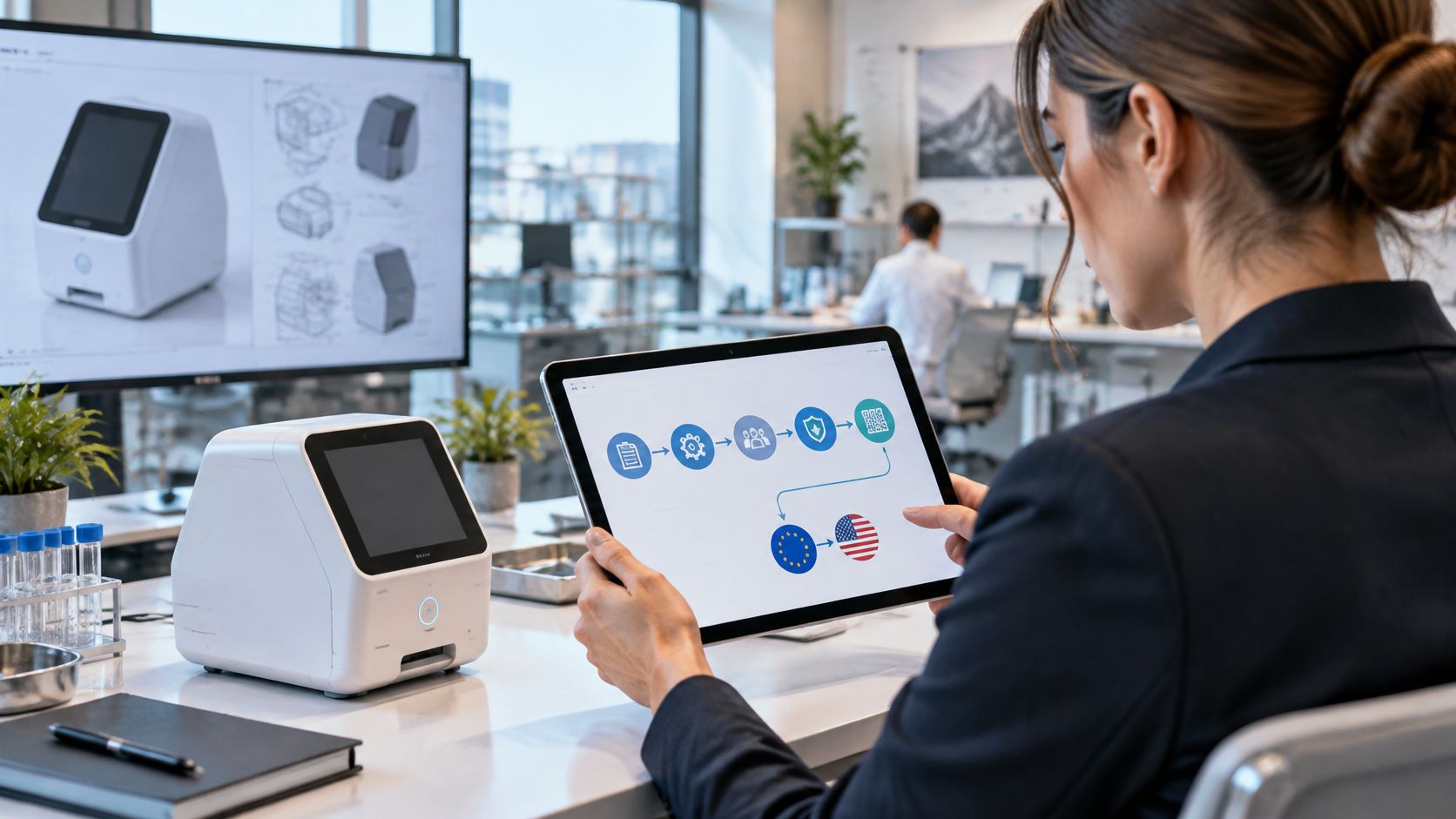
For a startup, the biggest regulatory risk is taking decisions in the wrong order. This article sets out the decisions a medical device or SaMD startup meets, in the order they depend on each other, for the EU and the US.
The decisions in order
| Decision | When | EU source | US source |
|---|---|---|---|
| Is it a medical device? | First, before the design is fixed | MDR Art. 2(1); MDCG 2019-11 Rev.1 | FD&C Act section 201(h), including the section 520(o) exclusions |
| Classification | Once the intended purpose is fixed | MDR Annex VIII | FDA classification regulation and product code |
| Quality management system | During development, before verification | MDR Art. 10(9) | QMSR, 21 CFR Part 820 |
| Technical documentation and clinical evidence | Planned during development | MDR Art. 10(3)-(4), Art. 61, Annexes II, III and XIV | Evidence for the chosen submission |
| Conformity route | After classification | MDR Art. 52 | 510(k), De Novo or PMA, where applicable |
| Actor registration and SRN | Before applying to a notified body, and before placing on the market | MDR Art. 31 | Not applicable |
| PRRC and authorised representative | Before placing on the market | MDR Art. 15 and Art. 11 | Not applicable |
| FDA small business status | Before paying an FDA fee | Not applicable | FDA small business determination programme |
Sources: MDR; MDCG 2019-11 Rev.1; FDA.
In our view, sequencing is the cheapest regulatory lever. Classification follows the intended purpose, the route follows the class, and the evidence must support the product you actually submit. Our article on regulatory strategy for the EU and US covers how to plan the route itself.
Step 1: intended purpose and qualification
Under MDR Article 2(1), software can be a medical device in its own right, including software for purposes such as prediction and prognosis. MDCG 2019-11 Rev.1 explains how to qualify and classify software. In the US, the device definition in section 201(h) of the FD&C Act excludes the software functions listed in section 520(o) (FDA). An EU conclusion does not decide the US answer.
In our view, write the intended purpose (users, indications, clinical context and claims) as a controlled document, and reassess it whenever a claim changes. Our article on software as a medical device covers qualification.
Step 2: class and conformity route
Under the MDR, the class follows from the intended purpose and the rules in Annex VIII. According to the Commission's factsheet, a notified body is needed for class IIa, IIb and III devices, and for class I devices that are sterile, have a measuring function or are reusable surgical instruments (for those aspects only). The technical documentation must state the class and justify the classification (Annex II).
In the US, the route depends on the device type: 510(k), De Novo or PMA, or none if the device is exempt. Our articles on classification of medical devices and 510(k) vs PMA cover both.
Step 3: quality management system and evidence
The MDR requires a quality management system proportionate to the risk class and type of device (Article 10(9)). In the US, the QMSR incorporates ISO 13485:2016 by reference. Our articles on the ISO 13485 quality management system and 21 CFR Part 820 explain both.
Manufacturers must draw up and keep the technical documentation up to date (Article 10(4); Annexes II and III) and carry out a clinical evaluation (Article 10(3), Article 61 and Annex XIV). Our article on SaMD technical documentation covers the structure for software.
In our view, size the procedures to the device. A startup does not need a large manufacturer's document library, but it does need procedures that produce the records its product requires.
Step 4: registration and named people
Under MDR Article 31, manufacturers must register in EUDAMED before placing a device on the market and, where a notified body is involved, before applying to it. Registration gives the manufacturer its Single Registration Number (SRN).
Two roles must be in place:
PRRC: the person responsible for regulatory compliance must meet the qualifications in Article 15(1). Micro and small enterprises do not need the PRRC within their organisation, but must have that person permanently and continuously at their disposal (Article 15(2)).
Authorised representative: a manufacturer outside the EU must designate a single EU authorised representative under a written mandate (Article 11). MedQAIR's Digital AR service covers that role.
In our view, name the owners of registration, the PRRC role and representation before the application file is finished, so they don't delay the start of the assessment.
Step 5: FDA fees and small business status
| FY 2027 fee | Standard (USD) | Small business (USD) |
|---|---|---|
| 510(k) | 28,653 | 7,163 |
| De Novo request | 191,020 | 47,755 |
| Establishment registration | 13,785 | 13,785 |
Source: Federal Register, FY 2027 user fees.
According to FDA's small business determination programme:
businesses with gross receipts or sales of USD 100 million or less, including affiliates, can qualify for reduced fees;
businesses with USD 30 million or less can also get the fee for their first PMA waived;
the establishment registration fee is not reduced;
foreign applicants use certification from their national tax authority, and FDA recommends submitting the request at least 60 days before the fee is due.
In our view, obtain the small business determination before paying any FDA application fee.
A hypothetical example
Hypothetical example: a Dutch micro-enterprise develops AI software that flags suspected findings on chest X-rays for radiologists.
Intended purpose: it documents the findings, users and workflow, then assesses qualification under Article 2(1).
Class: it applies Annex VIII and records the rationale in the technical documentation.
QMS: it builds its quality management system around ISO 13485:2016.
Registration: it registers in EUDAMED and obtains its SRN before applying to a notified body.
PRRC: it contracts a qualified PRRC who is permanently and continuously available.
US: before paying an FDA fee, it obtains a small business determination using Dutch tax certification.
Our case study of an AI medtech startup shows how one company went through CE marking in practice.
Conclusion
A startup's regulatory path is a chain of dependent decisions: intended purpose, class, route, quality system and evidence, then registration, named people and fees.
In our view, fix the intended purpose first, repeat the dependent decisions whenever a claim changes, and confirm current EU and US requirements before committing budget.
If you need help building your regulatory roadmap, our regulatory strategy team can help, or contact MedQAIR.
Frequently asked questions
What is the first regulatory decision for a medical device startup?
The intended purpose. It decides whether the product is a medical device, its class and its route.
Does a startup need its own PRRC?
Not necessarily. Micro and small enterprises may use an external PRRC who is permanently and continuously at their disposal (MDR Article 15(2)).
Do all class I devices avoid a notified body?
No. Class I devices that are sterile, have a measuring function or are reusable surgical instruments need a notified body for those aspects.
When should a startup register in EUDAMED?
Before applying to a notified body, where one is involved, and before placing a device on the market.
How can a startup reduce FDA fees?
By obtaining an FDA small business determination before paying. For FY 2027, a 510(k) costs USD 7,163 instead of USD 28,653 for a qualifying small business.