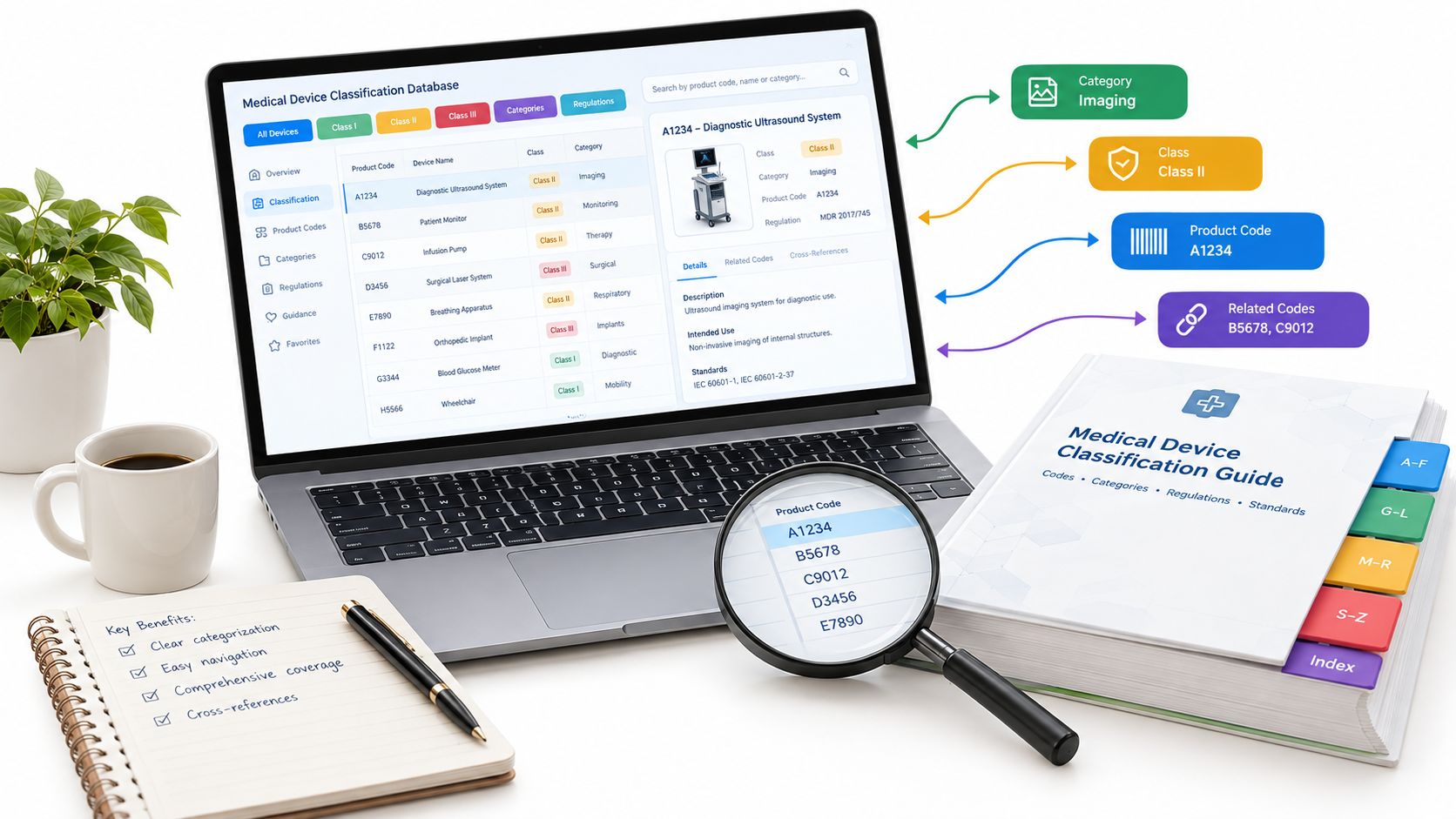
FDA has classified more than 1,700 distinct types of devices and organised them into 16 medical specialty panels in 21 CFR Parts 862 to 892 (FDA). The Product Classification Database is the index to those regulations, and its files are updated every Sunday (FDA). On 17 August 2026, FDA asked for public comment on a proposed list of accessories that may be suitable for distinct classification in Class I.
The database is where most US classification work starts, but it is an index, not the law. This article explains what the database contains, how to search it, how to read a product code record, and what to do when nothing fits.
What the database is
According to FDA, the database contains device names and their associated product codes. The name and product code identify the generic category of a device, and the product code is based on the classification in 21 CFR Parts 862 to 892.
A product code describes a generic device type, not a brand or model. It does not clear or approve anything, and two products with the same code are not automatically equivalent.
In our view, the database answers "where should I look?", and the regulation answers "what applies?". Keep a record of the search terms, the product code chosen, the regulation number and the reasoning that links the entry to your intended use. A printout without that reasoning is not a classification rationale.
The 16 panels
FDA groups the classification regulations into panels by medical specialty. Some parts cover more than one specialty, which is why the table has 19 rows.
| Code | Medical specialty | 21 CFR |
|---|---|---|
| 73 | Anesthesiology | Part 868 |
| 74 | Cardiovascular | Part 870 |
| 75 | Chemistry | Part 862 |
| 76 | Dental | Part 872 |
| 77 | Ear, Nose and Throat | Part 874 |
| 78 | Gastroenterology and Urology | Part 876 |
| 79 | General and Plastic Surgery | Part 878 |
| 80 | General Hospital | Part 880 |
| 81 | Hematology | Part 864 |
| 82 | Immunology | Part 866 |
| 83 | Microbiology | Part 866 |
| 84 | Neurology | Part 882 |
| 85 | Obstetrical and Gynecological | Part 884 |
| 86 | Ophthalmic | Part 886 |
| 87 | Orthopedic | Part 888 |
| 88 | Pathology | Part 864 |
| 89 | Physical Medicine | Part 890 |
| 90 | Radiology | Part 892 |
| 91 | Toxicology | Part 862 |
Source: FDA, Device Classification Panels.
For each device type, the regulation gives a description including the intended use, the class (I, II or III) and information on marketing requirements.
How to search
The search screen lets you search by device name, product code, regulation number, panel and other fields. In practice:
search by device name when you know FDA's generic term;
search by product code when you found a code elsewhere, for example in a competitor's 510(k) summary;
browse by panel or regulation number when you only know the specialty area.
Start broad. FDA's generic names are often written in reverse order, such as "system, image processing, radiological", so short keyword searches work better than full product names.
For bulk analysis, FDA also publishes downloadable product code files.
Reading a product code record
The record for product code LLZ shows what each field contains:
| Field | LLZ record | What it tells you |
|---|---|---|
| Device | system, image processing, radiological | FDA's generic name |
| Regulation Description | Medical image management and processing system | Title of the regulation |
| Regulation Medical Specialty / Review Panel | Radiology | Panel responsible |
| Premarket Review | OHT8, Radiological Imaging Devices and Electronic Products | FDA office that reviews submissions |
| Submission Type | 510(k) | Usual premarket route |
| Regulation Number | 892.2050 | The binding regulation |
| Device Class | 2 | Class II |
| TPLC | Link to report | Premarket and postmarket history for the code |
| GMP Exempt? | No | Whether the device is exempt from GMP requirements |
| Summary Malfunction Reporting | Eligible | Whether summary reporting can be used |
| Implanted Device? / Life-Sustain/Support Device? | No / No | Flags that affect requirements |
| Recognized Consensus Standards | Includes the DICOM set (NEMA PS 3.1 to 3.20) | Standards FDA recognises for the device type |
| Third Party Review | Eligible | Whether an accredited third party can review the 510(k) |
Source: FDA, product code LLZ, checked October 2026.
The next step is always the regulation itself, here 21 CFR 892.2050. Read the identification text and compare it with your intended use and indications for use.
Exemptions
Many Class I devices and some Class II devices are exempt from 510(k). The exemption is stated in the classification regulation and is subject to the limitations in the ".9" section of each part (21 CFR 862.9 to 892.9). FDA lists them on its Class I and Class II exemptions page.
An exempt device is still regulated. According to FDA, general controls such as registration and listing, labelling and good manufacturing practices still apply. Our article on FDA device listing covers the registration and listing step.
When no product code fits
If no product code matches your intended use, there are three possible explanations: the search terms were too narrow, the product may not be a device, or the device type is new.
Not sure it is a device: FDA explains the test on how to determine if your product is a medical device.
Need FDA's view: a 513(g) request for information asks FDA how it would classify and regulate the product. A user fee applies.
New device type: a device with no predicate is automatically Class III under section 513(f)(1). If general controls, or general and special controls, can provide reasonable assurance of safety and effectiveness, a De Novo request can classify it into Class I or II. A granted De Novo creates a new classification regulation that later devices can use as a predicate.
Our articles on De Novo review and Class 3 medical devices cover these routes.
Connected databases
The product code links the classification record to FDA's other medical device databases:
510(k), De Novo and PMA databases: for predicate research and earlier decisions on the same code;
Registration and Listing: who markets devices under the code;
TPLC: premarket and postmarket history in one report;
Recognized Consensus Standards: standards FDA recognises for the device type;
AccessGUDID: UDI data for devices under the code.
In our view, the TPLC report is the most underused. It shows clearances, adverse events and recalls for the code on one page, which is useful input for risk management and the regulatory strategy.
Conclusion
The Product Classification Database is the starting point for US classification. It links a generic device type to its regulation, class, review office and related databases. The binding rule remains the regulation in 21 CFR Parts 862 to 892, read against your intended use.
In our view, a good classification record shows the search, the chosen code, the regulation text and why it fits. That record then feeds the 510(k), De Novo or PMA strategy, and registration and listing.
If you need help classifying a device for the US market, our regulatory strategy team can help, or contact MedQAIR.
Frequently asked questions
What is an FDA product code?
A three-letter code that identifies a generic device type. It links the classification regulation to FDA's other device databases.
Is the database entry legally binding?
No. The binding classification is in the regulation in 21 CFR Parts 862 to 892, and in classification orders such as De Novo grants. The database is an index.
How often is the database updated?
According to FDA, the product code files are updated every Sunday.
What if there is no product code for my device?
Check your search terms first. If nothing fits, you can ask FDA through a 513(g) request, or, for a new device type, consider a De Novo request.
Are exempt devices free of FDA requirements?
No. Exemption only removes the 510(k). General controls, including registration and listing, labelling and good manufacturing practices, still apply unless the regulation says otherwise.