The Medical Device Amendments were signed into law on 28 May 1976. Devices first distributed on or after that date are postamendment devices (FDA: PMA Historical Background). Under section 513(f)(1) of the FD&C Act, a new type of device is automatically designated class III unless it is reclassified, for example through De Novo (86 FR 54826, 5 October 2021).
For novel software, "Class III" can therefore be a default label rather than a verdict on risk. This article explains what FDA Class III means, how devices end up there, the routes to market, and how it differs from class III under the EU MDR.
What Class III means
FDA describes Class III as the highest-risk class, subject to general controls and premarket approval (PMA) (FDA: Regulatory Controls). The legal definition in 21 CFR 860.3 reads:
"Class III means the class of devices for which premarket approval is or will be required in accordance with section 515 of the Federal Food, Drug, and Cosmetic Act. A device is in class III if insufficient information exists to determine that general controls are sufficient to provide reasonable assurance of its safety and effectiveness, or that application of special controls described in the definition of 'Class II' in this section in addition to general controls, would provide such assurance, and if, in addition, the device is life-supporting or life-sustaining, or for a use which is of substantial importance in preventing impairment of human health, or if the device presents a potential unreasonable risk of illness or injury."
According to FDA's PMA page, Class III devices require a PMA under section 515 of the FD&C Act, and a Class III device that fails to meet PMA requirements is considered adulterated under section 501(f) and may not be marketed.
How devices become Class III
FDA's PMA Historical Background distinguishes three groups:
Preamendment devices: marketed before 28 May 1976.
Postamendment devices: first distributed on or after that date.
Transitional devices: previously regulated as drugs, such as intraocular lenses (21 CFR 886.3600).
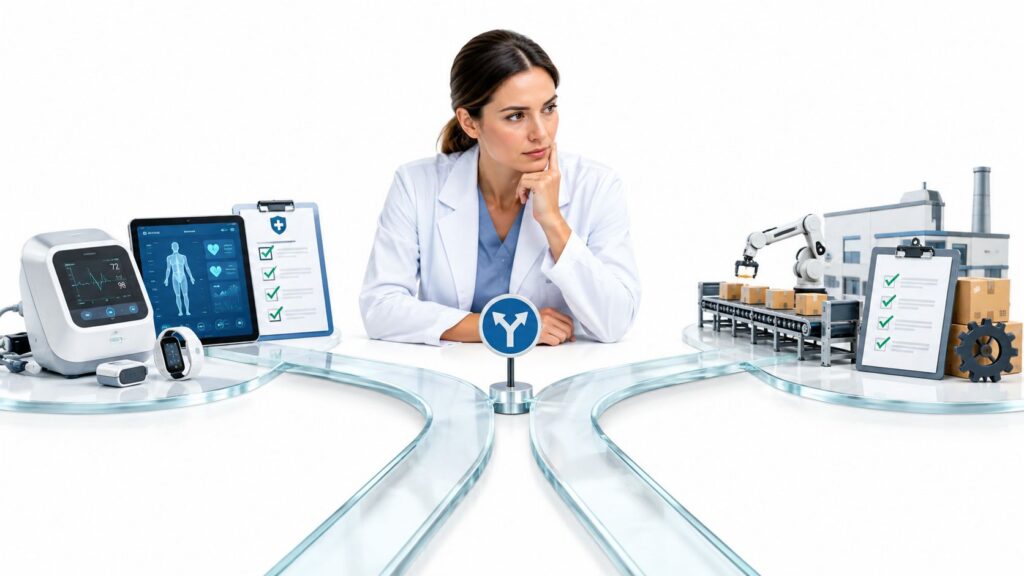
A new postamendment device type with no predicate is automatically class III under section 513(f)(1). In our view, for a novel device this is a starting point, not a conclusion. The real question is whether general controls, or general and special controls, could provide reasonable assurance of safety and effectiveness. If they could, De Novo is the route; if not, a PMA is needed. Our article on De Novo review covers that route in detail.
Preamendment Class III and the Class III 510(k)
For preamendment Class III devices, a PMA is only required once FDA has published a regulation calling for it. Until then, these devices go through a 510(k).
The CFR shows which case applies. If the classification regulation states "No effective date has been established of the requirement for premarket approval", a Class III 510(k) should be submitted (FDA PMA page). FDA also advises searching the Product Classification, PMA and 510(k) databases by product code where it is unclear whether a device needs a PMA.
Routes to market
| Route | When it applies | Outcome | Source |
|---|---|---|---|
| PMA | Class III device subject to premarket approval under section 515 | Approval | FDA PMA page |
| Class III 510(k) | Preamendment Class III device for which no effective date for PMA has been set | Clearance | FDA PMA page |
| De Novo | No predicate, and general or general and special controls provide reasonable assurance of safety and effectiveness | Classification into class I or II | 86 FR 54826 |
| HDE | Humanitarian use device for a disease or condition affecting not more than 8,000 individuals in the US per year | Approval, exempt from the effectiveness requirements of sections 514 and 515 | FDA HDE page |
Sources: FDA PMA, PMA Historical Background and HDE pages; De Novo final rule.
The humanitarian device exemption (HDE) was created by the Safe Medical Devices Act of 1990. The 8,000-person threshold comes from section 3052 of the 21st Century Cures Act. An HDE device is exempt from the effectiveness requirements of sections 514 and 515, and profit on it is limited.
Class III under the EU MDR
The EU uses the same label for a different system. According to MDCG 2021-24 Rev.1, sections 2.1 to 2.5:
Article 51 of the MDR divides devices into classes I, IIa, IIb and III, assigned by the rules in Annex VIII;
the class determines the conformity assessment procedure under Article 52, with more notified body involvement as the class rises;
under Rule 11, software is class III where it provides information used to take decisions that may cause death or an irreversible deterioration of a person's state of health. MDCG 2021-24 gives the example of image analysis software used for treatment decisions in acute stroke;
for class IIb and III devices, the periodic safety update report must be updated at least annually.
In our view, Rule 11 is where most SaMD teams meet class III. The consequence of the decision the software supports drives the class, not whether the software uses AI.
What EU class III brings
Clinical investigations: under Article 61(4), clinical investigations are required for implantable and class III devices, unless one of the exemptions in Article 61(4) to (6) applies. MDCG 2023-7 explains those exemptions.
Clinical evaluation consultation procedure (CECP): under Article 54, this applies to class III implantable devices and to class IIb active devices intended to administer or remove a medicinal product, with the exceptions described on the Commission's expert panels page. Class III software that is neither implantable nor such an active device falls outside it.
Summary of safety and clinical performance (SSCP): under Article 32, implantable and class III devices need an SSCP, validated by the notified body and made public through EUDAMED (MDCG 2019-9 Rev.1).
Because Article 61(4) applies by default, in our view clinical evidence for class III software should be planned from the start, not after classification is confirmed. Our article on the clinical evaluation report covers the wider clinical evaluation.
US Class III and MDR class III compared
| US Class III | MDR class III | |
|---|---|---|
| Legal basis | FD&C Act section 513; 21 CFR 860.3 | MDR Article 51 and Annex VIII |
| How assigned | Classification regulation, or automatically for new device types under 513(f)(1) | Annex VIII rules, including Rule 11 for software |
| Route to market | PMA, Class III 510(k) for some preamendment devices, or HDE; De Novo moves the device to class I or II | Notified body conformity assessment under Article 52 |
| Clinical evidence | Valid scientific evidence for a PMA | Clinical investigations under Article 61(4), unless an exemption applies |
| Public summary | Not covered in this comparison | SSCP under Article 32, public through EUDAMED |
Sources: FDA; 21 CFR 860.3; MDR; MDCG 2021-24 Rev.1; MDCG 2019-9 Rev.1.
The classes are not equivalent. A device can be class III in one system and a lower class in the other.
A hypothetical example
Hypothetical example: a Dutch SaMD company has developed novel image analysis software that informs treatment decisions.
US: there is no predicate, so the software is automatically class III. The company assesses whether general and special controls could provide reasonable assurance of safety and effectiveness. If they could, it prepares a De Novo request; if not, a PMA.
EU: the company applies Rule 11. If the decisions the software informs may cause death or irreversible deterioration of health, it is class III. That brings notified body conformity assessment, clinical investigations under Article 61(4) unless an exemption applies, and an SSCP. The CECP would not apply, because the software is neither implantable nor an active device administering a medicinal product.
The same intended purpose feeds both analyses, but each system reaches its own result. Our article on SaMD technical documentation explains how to keep both classification rationales in one file.
Conclusion
FDA Class III means a PMA unless a narrower route applies, and for a novel device it is often a default that De Novo can change. MDR class III is assigned by different rules and brings its own obligations: notified body assessment, clinical investigations by default and a public SSCP.
In our view, the classification should be worked out for each market separately and early, because it decides the clinical evidence plan. Our articles on CE marking for medical devices and medical device regulatory strategy for the EU and US cover the wider pathway.
If you need help classifying your device and planning the route to market, our regulatory strategy team can help, or contact MedQAIR.
Frequently asked questions
Is FDA Class III the same as EU class III?
No. The labels match, but the criteria, procedures and consequences differ. A device's US class does not determine its MDR class.
Does every Class III device need a PMA?
No. Some preamendment Class III devices go through a Class III 510(k) until FDA requires a PMA, and humanitarian use devices can use an HDE. A novel device that is automatically class III can be reclassified through De Novo.
What is a Class III 510(k)?
A 510(k) for a preamendment Class III device whose classification regulation states that no effective date has been established for the PMA requirement.
What is an HDE?
A humanitarian device exemption for devices intended for a disease or condition affecting not more than 8,000 individuals in the US per year. It is exempt from the effectiveness requirements of sections 514 and 515, and profit is limited.
Does Rule 11 make all AI software class III?
No. Rule 11 looks at the decisions the software informs and their possible consequences. Software can be class IIa, IIb or III under Rule 11, whether or not it uses AI.