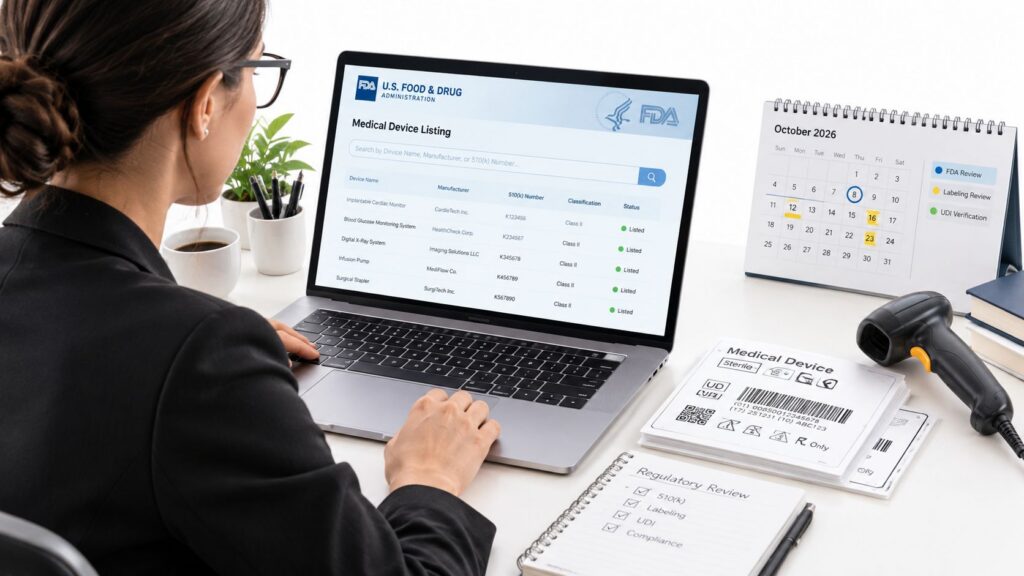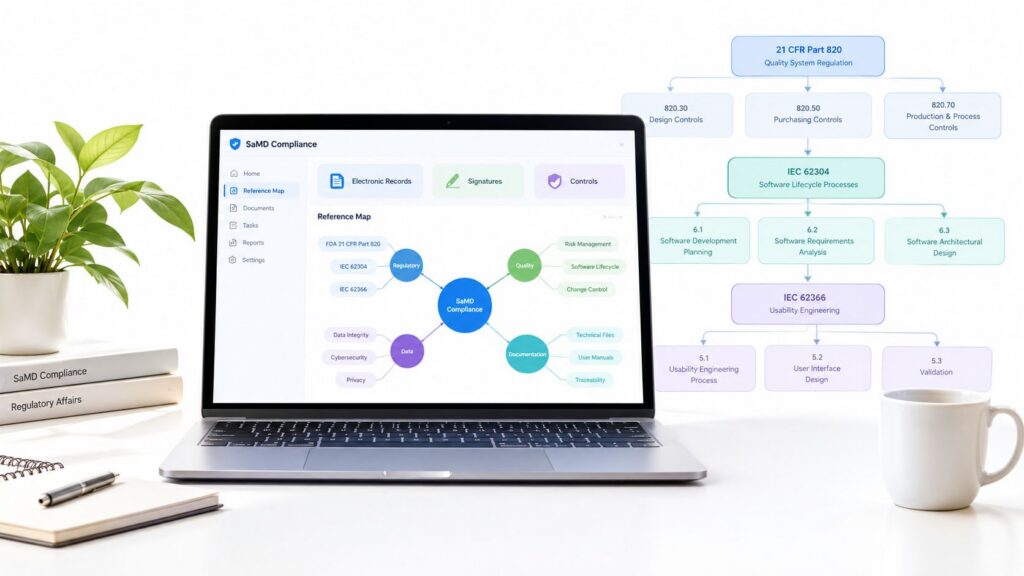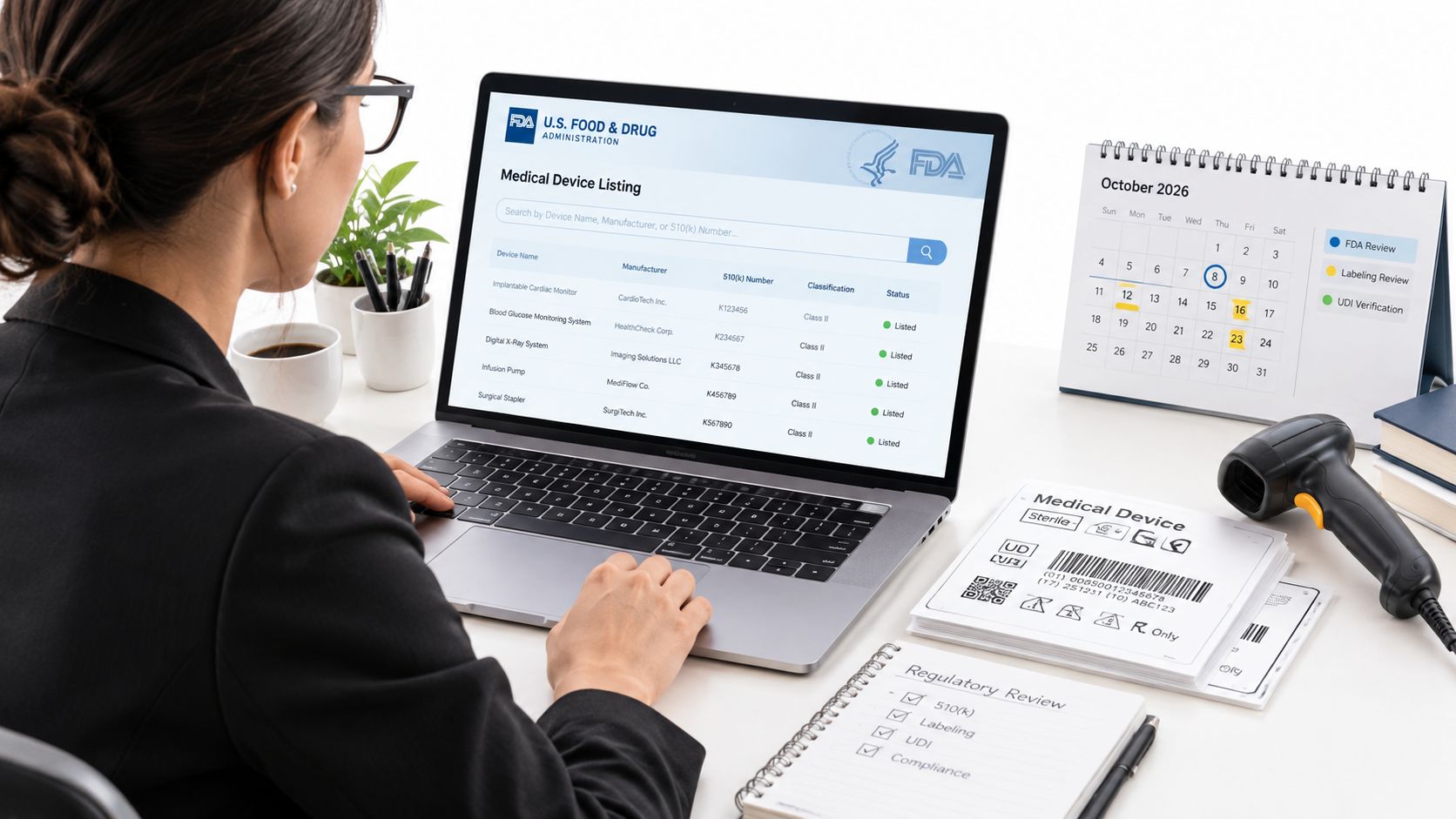
Device listing is the part of FDA registration that most teams touch once a year and otherwise forget. That is a mistake. Since the Food and Drug Administration Amendments Act of 2007, all registration and listing information has to be submitted electronically unless FDA grants a waiver (FDA: How to Register and List), and every listing on file must be reviewed between 1 October and 31 December each fiscal year under 21 CFR 807.22(b)(3). This article explains what a device listing contains, how FDA assigns listing numbers, when a listing must be created, updated or discontinued, and how the workflow runs in FURLS.
Background and scope of FDA device listing
Registration identifies the establishment. Listing identifies what that establishment does to which device. Both sit in 21 CFR Part 807, and both are submitted through FDA's Unified Registration and Listing System (FURLS) and its Device Registration and Listing Module.
The annual cycle is fixed. The fiscal year 2027 registration period opened on 1 October 2026, and the establishment registration fee for that year was published in the FY 2027 medical device user fee notice. The listing review runs in the same window, and FDA expects the accuracy of all listing information to be confirmed each year, even if nothing has changed.
Who lists depends on the role. Manufacturers, specification developers, contract manufacturers, contract sterilisers, repackagers, relabellers, remanufacturers and single-use device reprocessors register and list. Initial importers register but meet their listing obligation by identifying the manufacturers of the devices they import (FDA: Who Must Register, List and Pay the Fee; 21 CFR 807.20(a)(5)). Foreign establishments also need a U.S. Agent, and must identify their known U.S. importers. For the wider set-up work across the EU and US, see our article on registration of medical devices.
Listing follows the legal and regulatory identity of the device: the establishment, the activity performed and the premarket basis. It does not follow a product catalogue or a website range.
Data requirements and listing numbers
21 CFR 807.25(g) sets out what each listing must contain:
| Information required per device listing | Exempt devices | Non-exempt devices | Source |
|---|---|---|---|
| Registration number and name of each establishment involved | Required | Required | 21 CFR 807.25(g)(1) |
| Product code | Required for devices exempt from premarket notification and approval, or in commercial distribution before 28 May 1976 | Not the listing basis | 21 CFR 807.25(g)(2) |
| Proprietary or brand name(s) | Required | Required | 21 CFR 807.25(g)(3) |
| FDA premarket submission number (510(k), PMA, De Novo, HDE) | Not applicable | Required | 21 CFR 807.25(g)(4) |
| Each activity performed at each establishment | Required | Required | 21 CFR 807.25(g)(5) |
Listing numbers follow the same logic. Under 21 CFR 807.28(f), FDA assigns one listing number for all devices exempt from premarket notification under a single product code, and one listing number for each FDA premarket submission number. A second 510(k) therefore means a second listing. A new brand name for the same cleared device does not.
Proprietary names deserve more attention than they usually get. FDA expects every current proprietary name under which the device is marketed in the US to be reported, including private-label names; there is no limit on the number of names, and entries such as "multiple" or "various" are not accepted (FDA registration and listing FAQ). FDA-assigned listing numbers are not published, and for contract manufacturers, contract sterilisers and private-label manufacturers the brand names and premarket number can be withheld from public view where they would reveal a confidential business relationship (21 CFR 807.37(b)).
If the proprietary name, the establishment or the activity changes, the listing has to change with it. In practice, the listing should be reconciled against the technical documentation and the premarket file, not against the marketing catalogue.
Timelines for initial listing and updates
The rules are event-driven, with an annual check on top.
| Event | Action | Source |
|---|---|---|
| Entering into a registrable operation | Register within 30 days and submit listing information at that time | 21 CFR 807.22(a) |
| Non-exempt device awaiting clearance or approval | List only after the 510(k), PMA, De Novo or HDE is cleared, granted or approved | FDA: How to Register and List |
| Foreign establishment | Submit listings before the device is imported or offered for import | 21 CFR 807.28(c) |
| Annual review | Review and update all listings between 1 October and 31 December, confirming accuracy even where nothing changed | 21 CFR 807.22(b)(3) |
| New exempt product code or new premarket submission number | Create a new listing | 21 CFR 807.28(b) |
| Additional establishment, or an activity added or stopped | Update the listing | 21 CFR 807.28(a) |
| All devices under a product code or premarket number discontinued | Discontinue the listing | 21 CFR 807.28(d) |
| Discontinued device returns to distribution | Reactivate the listing and update its details | 21 CFR 807.28(e) |
FDA's instruction on non-exempt devices is explicit: a device that requires premarket notification or approval can only be listed after the submission is cleared or approved, and if that is the establishment's only device, it should not register until then (FDA: How to Register and List).
Changes can also be made outside the annual window, for example when a device is introduced, changed or removed from commercial distribution (21 CFR 807.22(b)(4)). Waiting for October to record a change that happened in March leaves the record wrong for months.
If you are planning parallel market entry in the EU and US, our article on medical device regulatory strategy for the EU and US covers how the two timelines interact.
Creating and managing listings in FURLS
FURLS works through two account types. The owner or operator holds the primary account and creates sub-accounts for official correspondents; each official correspondent handles registration and listing for the establishments assigned to them. FDA is clear that a firm with an existing FURLS account must not create a new one, because a new account cuts off access to the existing registration. Designating an official correspondent does not affect the liability of the owner or operator (21 CFR 807.25(f)).
The initial sequence, based on FDA's instructions:
Pay the annual establishment registration fee on the Device Facility User Fee site and keep the Payment Identification Number (PIN) and Payment Confirmation Number (PCN).
Log in to FURLS and open the Device Registration and Listing Module.
Register the facility, or select the existing registration.
For a non-exempt device, enter the premarket submission number, the proprietary names and the activities performed.
For an exempt device, leave the premarket number blank, select the product code, then add the activities and proprietary names.
Certify the information, submit, and enter the PIN and PCN when prompted.
Use Change, Cancel or Reactivate Listing for later updates.
The PIN and PCN step is where registrations most often stall. FDA states that without both numbers the registration is incomplete, and that the PCN can take several days to arrive after payment.
Hypothetical example: a Dutch software manufacturer receives 510(k) clearance for its SaMD. It pays the fee, registers, and creates one listing under that 510(k) number with its proprietary name and the activity "manufacturer". When it later markets the same software under a second brand name, it adds the name to the existing listing. When a later version needs a new 510(k), FDA assigns a separate listing to that new submission number. If every device under the first 510(k) is withdrawn from the US market, the first listing is discontinued.
Supply chain dependencies and record control
Contract manufacturers, contract sterilisers and foreign exporters depend on the legal manufacturer's listing. For non-exempt devices, FURLS won't let them list until the manufacturer, specification developer, remanufacturer, reprocessor or repacker/relabeller has listed the device first (FDA registration and listing FAQ). Initial importers identify the manufacturers whose devices they import, and FDA notes that out-of-date importer information may lead to manual import entry review.
Imports also depend on the numbers in FURLS. To import a listed device into the US, the importer needs the registration number or the owner/operator number, together with the listing number of the device.
Missing a deadline has a defined consequence. Under 21 CFR 807.22(c), failure to submit required information on time puts the establishment in "failed to register" or "failed to list" status. The establishment is not considered active, and its registration and listing information may not appear on the FDA website until the information is submitted and processed.
Electronic registration and listing submissions must comply with Part 11, except for §11.10(b), (c) and (e) and the corresponding requirements in §11.30 (21 CFR 807.25(a)). Our 21 CFR Part 11 reference explains those controls in more detail.
Registration and listing are not approval. Registration or a registration number does not denote approval of the establishment or its products, and any representation suggesting otherwise is misbranding (21 CFR 807.39). Likewise, the assignment of a listing number is not an FDA determination of the status of any device (21 CFR 807.35(c)).
For SaMD and AI-enabled devices, rapid releases, rebranding, legal-name changes and acquisitions are where listings drift. Treat each of these as a trigger to check the listing, not just the label.
Conclusion
A device listing is short, but it has to match four things at all times: the establishment, the activity, the proprietary names and the premarket basis. The annual review between 1 October and 31 December is the minimum. The real control is updating the listing when the regulated facts change.
If you need support with US registration and listing alongside other markets, our global market registrations team can help, or contact MedQAIR.
Frequently asked questions
Can I list a device before my 510(k) is cleared?
No. FDA states that a device requiring premarket notification or approval can only be listed after the 510(k), PMA, De Novo or HDE is cleared or approved. If it is your only device, FDA advises not to register the establishment until then.
Is one listing enough for several brand names?
Yes, if they are the same device under the same premarket submission number or exempt product code. FDA assigns one listing number per premarket submission number, or per product code for exempt devices (21 CFR 807.28(f)), and all current proprietary names, including private-label names, are added to that listing.
What happens if the annual review is missed?
Under 21 CFR 807.22(c), the establishment goes into "failed to register" or "failed to list" status. It is not considered active, and its information may not appear on the FDA website until the required information is submitted and processed.
Does a device listing mean FDA approval?
No. Registration does not denote approval of the establishment or its products (21 CFR 807.39), and a listing number is not an FDA determination of the device's status (21 CFR 807.35(c)). Clearance or approval comes only from the premarket decision.
Who should hold the official correspondent role?
The owner or operator designates the official correspondent for each establishment and creates their FURLS sub-account. The official correspondent submits registration and listing information and receives FDA correspondence, but the designation does not affect the liability of the owner or operator (21 CFR 807.25(e) and (f)).
When do I need to update a listing during the year?
When an establishment or activity is added or removed, when a new exempt product code or premarket number is introduced, when a device is discontinued or reactivated, or when proprietary names change (21 CFR 807.22(b)(4) and 807.28). Don't wait for the annual review.