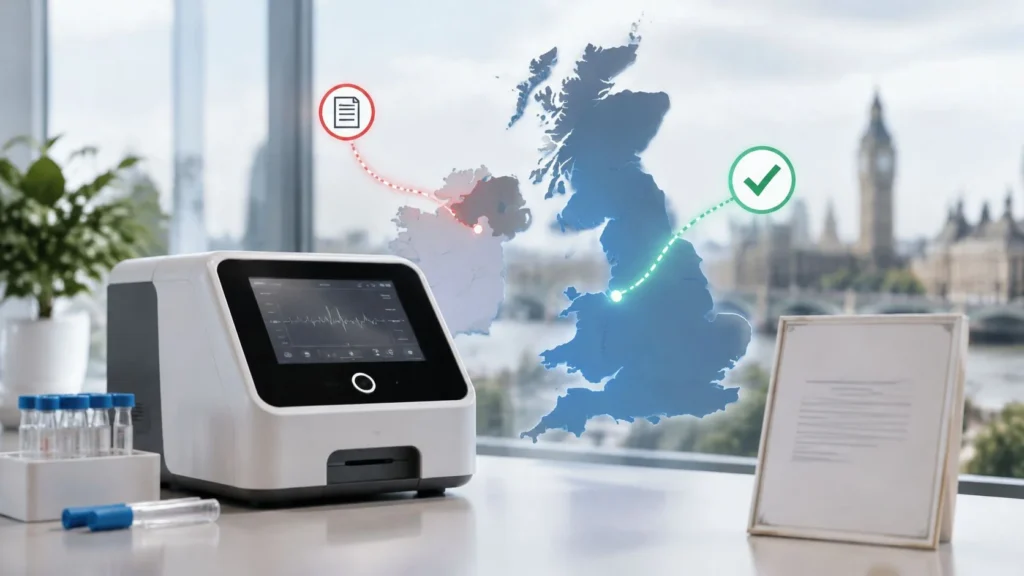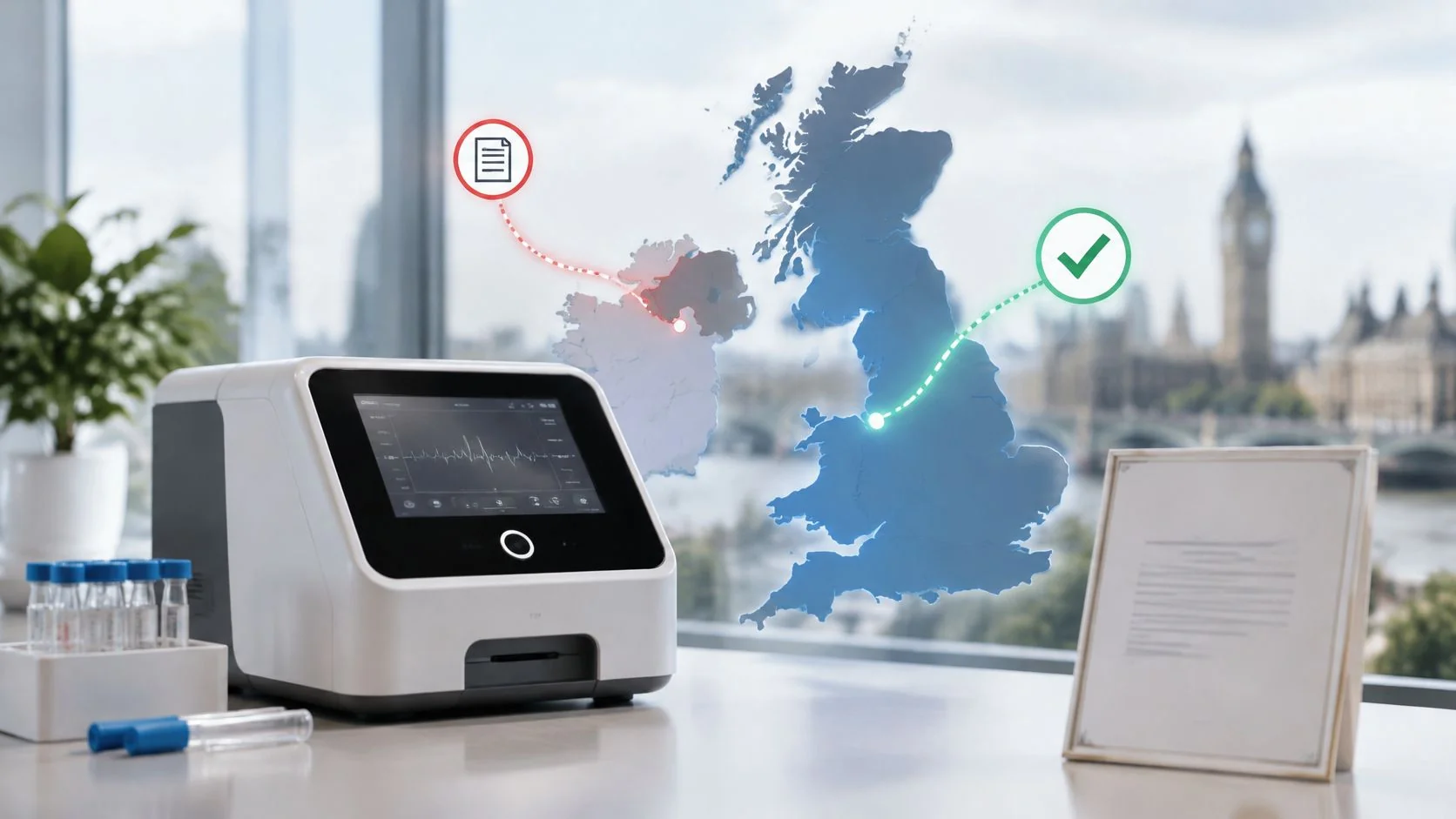
On 21 October 2026, the UK government confirmed that it will continue to accept CE-marked medical devices in Great Britain on a long-term basis. The UKCA mark remains the domestic route, but for many manufacturers it is no longer the only realistic one.
Whichever mark a device carries, the same domestic duties apply: a UK Responsible Person for manufacturers outside the UK, registration with the MHRA, and post-market surveillance under the GB rules. This article explains the UKCA routes, the CE acceptance dates, those domestic duties, and the separate position in Northern Ireland.
The legal basis
UKCA marking is based on the UK Medical Devices Regulations 2002 (UK MDR 2002, SI 2002/618). Part II covers general medical devices, Part III active implantable devices and Part IV in vitro diagnostic devices. According to the MHRA, the UKCA requirements are currently based on the annexes of the old EU directives (MDD, AIMDD and IVDD), as modified by Schedule 2A to the UK MDR 2002.
The EU MDR and IVDR do not apply in Great Britain. They do apply in Northern Ireland, which is covered below.
UKCA routes by device class
| Class (general medical devices) | Route | UK approved body needed? |
|---|---|---|
| Class I, not sterile and no measuring function | Manufacturer's self-declaration | No |
| Class I, sterile or with a measuring function | Approved body assessment of the sterile or measuring aspects | Yes |
| Class IIa, IIb and III | Approved body assessment | Yes |
Source: MHRA, Medical devices: conformity assessment and the UKCA mark.
UK approved bodies are designated by the MHRA and cannot carry out assessments for CE marking. The UK Market Conformity Assessment Bodies (UKMCAB) database is the definitive register of approved bodies and their scope.
In our view, classify the device under the UK MDR 2002 rules rather than assuming the EU MDR class carries over. The UK rules still follow the directives, so the result can differ.
For software, the directive rule still applies: software that drives or influences a device falls in the same class as that device, and standalone software is classified in its own right. Whether software is a medical device depends on its intended purpose, as shown in the labelling, instructions for use and promotional material, including app store text. Our article on software as a medical device covers qualification.
CE acceptance in Great Britain
Under current law, CE-marked devices can be placed on the GB market until these dates:
| Device | Accepted until |
|---|---|
| General medical devices under the EU MDD or AIMDD | Sooner of certificate expiry or 30 June 2028 |
| IVDs under the EU IVDD | Sooner of certificate expiry or 30 June 2030 |
| General medical devices under the EU MDR, including custom-made devices | 30 June 2030 |
| IVDs under the EU IVDR | 30 June 2030 |
Source: MHRA, Regulating medical devices in the UK.
The government response to the consultation, which ran from 16 February to 10 April 2026 and received 1,056 responses, sets out what comes next. The government intends to legislate to:
recognise CE-marked devices certified under the EU MDR and IVDR indefinitely;
align GB transitional arrangements for MDD-compliant devices with the EU timelines.
Most respondents did not support a separate reliance route for devices classified higher in GB than in the EU.
In our view, plan against the dates in the table until the legislation is made. An announced intention is not yet law.
CE acceptance does not remove the domestic duties. According to the government response, CE-marked devices will still need a UK Responsible Person, MHRA registration and GB post-market surveillance. Our article on the CE mark for medical devices covers the EU route.
UK Responsible Person and MHRA registration
| Duty | What the MHRA requires |
|---|---|
| UK Responsible Person | Manufacturers outside the UK must appoint one to register and act on their behalf. The UK Responsible Person must have written evidence of the manufacturer's authority |
| Who can act | An importer or distributor can also act as UK Responsible Person |
| Labelling | Where the UKCA mark is affixed, the UK Responsible Person's name and address must be on the labelling, outer packaging or instructions for use. Not required for devices that carry only the CE mark |
| Registration | Devices must be registered with the MHRA before they are placed on the GB market. Fees may apply to new registrations and changes |
Source: MHRA, Regulating medical devices in the UK.
Without registration, the device cannot lawfully be placed on the GB market. The UK Responsible Person also has duties of its own under the UK MDR 2002, such as making sure the declaration of conformity and technical documentation have been drawn up.
In our view, appoint the UK Responsible Person and agree the documentation handover before the registration, not in the week before launch. MedQAIR's in-country representation service covers representative roles, including support in the UK through its partner network.
Post-market surveillance in Great Britain
SI 2024/1368 added new post-market surveillance requirements to the UK MDR 2002. According to the MHRA's guidance:
the requirements apply to devices placed on the market or put into service in GB from 16 June 2025, whether they carry the CE or the UKCA mark (regulation 44ZD);
individual devices placed on the market before then remain under the previous requirements;
if a model was on the market both before and after that date, two sets of requirements apply, and the MHRA notes that a single PMS system may be simpler.
In our view, the GB post-market surveillance plan should be in place before the first device is placed. Our article on post-market surveillance explains the structure of the plan and report.
Northern Ireland
Under the Windsor Framework, the EU MDR and IVDR apply in Northern Ireland, not the UKCA rules. According to the MHRA's Northern Ireland guidance:
| Topic | Position in Northern Ireland |
|---|---|
| Marking | CE marking is required. Where a UK notified body was used, the device carries a combined CE and UK(NI) marking, accepted across the UK but not in the EU |
| Representative | A GB-based manufacturer needs a sole authorised representative based in the EU or Northern Ireland |
| Registration | Actors register in EUDAMED; four EUDAMED modules became mandatory on 28 May 2026. Custom-made devices placed on the NI market are still registered on DORS |
| Access to GB | Qualifying Northern Ireland goods with a valid CE marking can be placed on the GB market indefinitely |
Source: MHRA, Regulation of medical devices in Northern Ireland.
For the EU or Northern Ireland authorised representative, MedQAIR's Digital AR service covers the role. For the EUDAMED registrations, MDIS helps manufacturers manage the device data. Our article on the authorised representative explains the EU duties.
A hypothetical example
Hypothetical example: a US SaMD manufacturer holds an EU MDR certificate and wants to sell in the whole UK.
Great Britain: it relies on CE acceptance, currently until 30 June 2030. It appoints a UK Responsible Person, who registers the device with the MHRA, and it runs GB post-market surveillance from the first device placed.
Northern Ireland: the CE mark applies. As a manufacturer outside the EU, it needs an authorised representative in the EU or Northern Ireland, and the device is registered in EUDAMED.
If it chose UKCA instead: it would classify the software under the UK MDR 2002 and use a UK approved body, unless the software is Class I without a sterile or measuring function.
Conclusion
The mark is the smaller decision. The UK Responsible Person, MHRA registration and GB post-market surveillance apply whether a device carries UKCA or CE, and Northern Ireland follows the EU rules.
In our view, check the transitional category of each device, put the representative and registration in place, map Northern Ireland separately, and track the legislation on indefinite CE recognition until it is made.
If you need help planning your route into the UK, our in-country representation team can help, or contact MedQAIR.
Frequently asked questions
Is the UKCA mark accepted in Northern Ireland or the EU?
No. Northern Ireland follows the EU MDR and IVDR and requires CE marking. The EU does not recognise UKCA.
How long can CE-marked devices be sold in Great Britain?
Under current law, MDD and AIMDD devices until the sooner of certificate expiry or 30 June 2028, and IVDD, EU MDR and EU IVDR devices until 30 June 2030 (IVDD also subject to certificate expiry). The government intends to legislate for indefinite recognition of EU MDR and IVDR devices.
Does a CE-marked device need a UK Responsible Person?
Yes, if the manufacturer is established outside the UK. The UK Responsible Person registers the device with the MHRA, whichever mark it carries.
Do the new GB post-market surveillance rules apply to CE-marked devices?
Yes. They apply to devices placed on the market or put into service in GB from 16 June 2025, regardless of certification.
Where can I check whether a UK approved body is designated?
In the UKMCAB database, which is the UK's register of approved bodies and their scope.