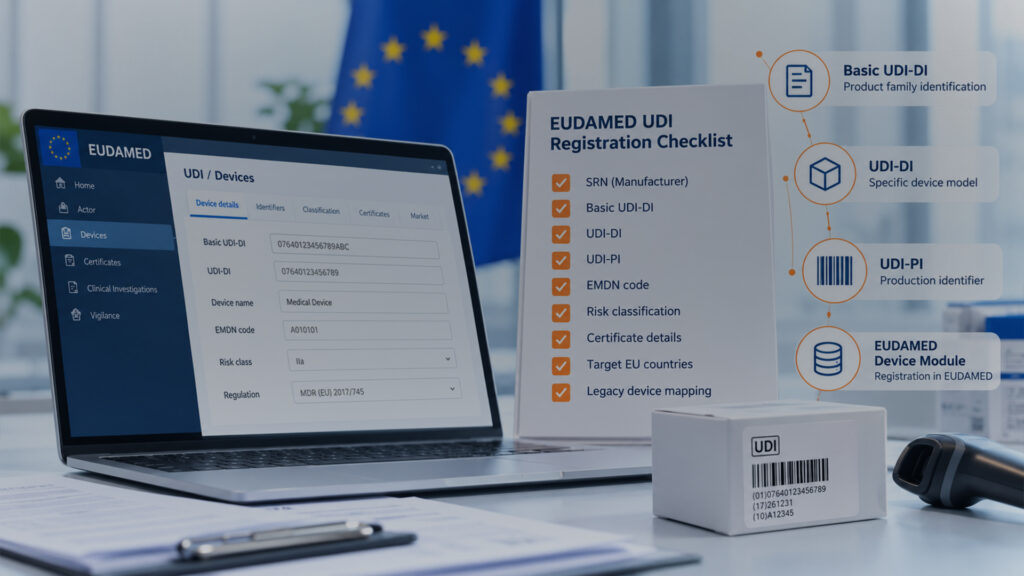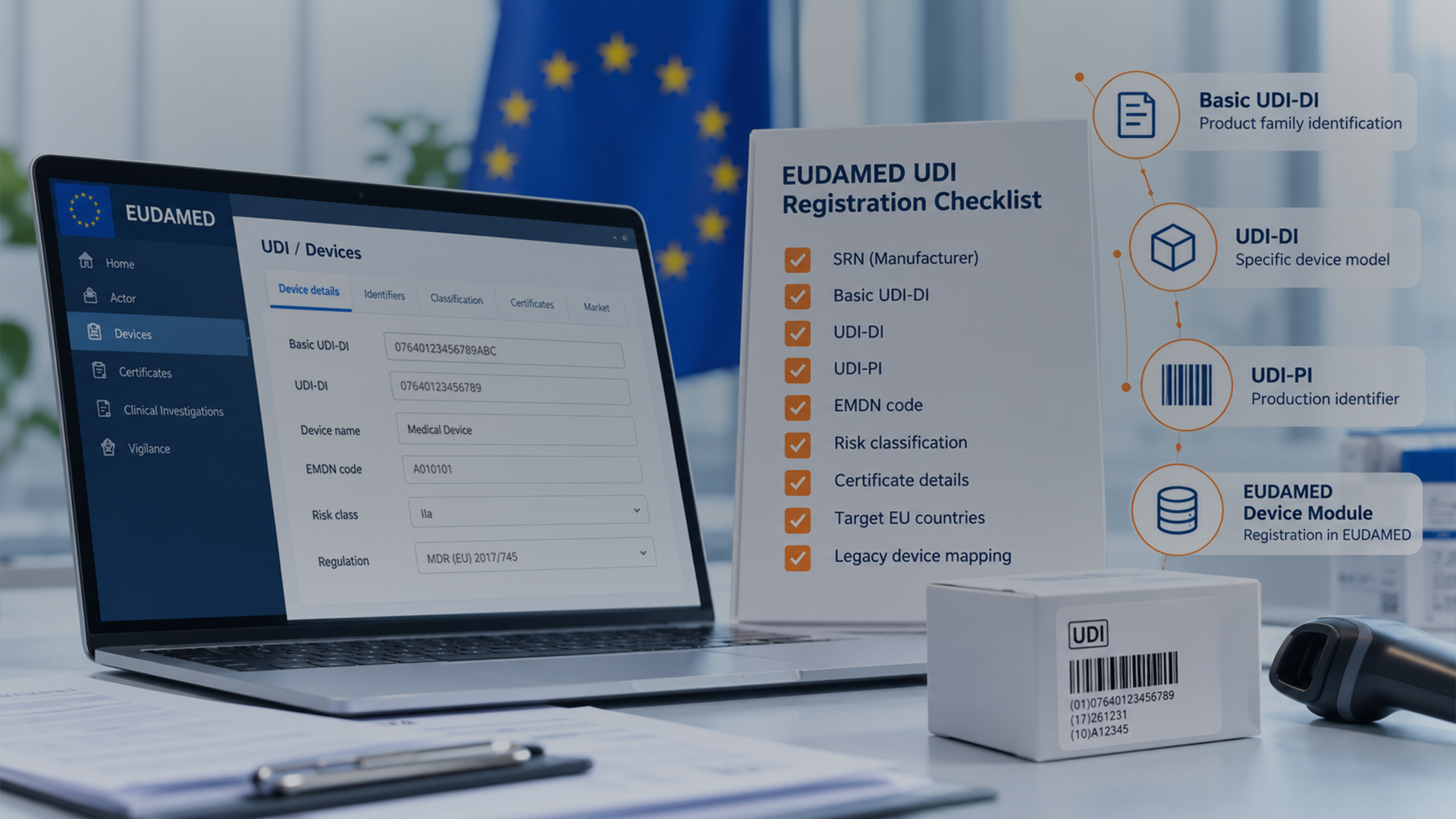
Using the EUDAMED UDI/Devices module became mandatory on 28 May 2026. This follows the Commission Decision (EU) 2025/2371, which formally declared the first four modules functional.
Published in the Official Journal back on 27 November 2025, that decision kicked off a six-month transition period under Regulation (EU) 2024/1860. Simply put: if you place medical devices on the EU market, active EUDAMED UDI registration is now a strict condition of market access.
To help you navigate EUDAMED device module preparation smoothly, this checklist lays out what needs to be registered and the exact data points to gather beforehand.
Two deadlines you are working against
Your timeline depends heavily on when your device enters the market:
- New devices: Any new device placed on the EU market from 28 May 2026 onward must be registered in the system before its first commercial placement. There is no grace period here.
- Existing devices: Devices already on the market prior to 28 May 2026 have until 28 November 2026. This 12-month window applies to legacy devices operating under the MDR Article 120 transitional regime, as well as equivalent IVDR provisions.
Confirming which category each product falls into before starting is essential. It dictates your deadline and changes the specific identifier format you will need to input.
Who can register, and the access you need first
Device registration is the manufacturer’s own obligation.
According to official EUDAMED user guides, Authorised Representatives (ARs) and Importers are not permitted to register devices or system and procedure packs on a manufacturer’s behalf. This is a common mistake among companies that outsource regulatory tasks to an AR and assume device-level database submissions are automatically covered.
If you appoint an EU Authorised Representative, our digital AR service keeps the actor and registration data connected without taking the registration duty off the manufacturer.
Before registering any device, you must hold a validated Single Registration Number (SRN). You obtain this through the EUDAMED Actor module, after which your relevant Competent Authority must validate it. Non-EU manufacturers must initiate this through their appointed EU Authorised Representative, though the ultimate device registration obligation still sits with the manufacturer. Think of actor registration as step zero – and make sure to build in extra time for authority approval.
Get the identifiers right before you touch the module
Most submission errors stem from mixing up identifiers. EUDAMED stores multiple codes within a single record, and they serve very different purposes:
- Basic UDI-DI: This acts as the primary grouping key in EUDAMED. It ties together devices sharing the same intended purpose, risk class, and core design or manufacturing characteristics. The Basic UDI-DI appears on your certificates, EU declaration of conformity, technical documentation, and (where applicable) Summary of Safety and Clinical Performance (SSCP). You assign it through your designated issuing entity under MDR Article 27 or IVDR Article 24.
- UDI-DI: This identifies the specific device model or variant. A single Basic UDI-DI can cover multiple UDI-DIs, but an individual UDI-DI can never map to more than one Basic UDI-DI.
- UDI-PI: The production identifier covering dynamic data like batch numbers, serial numbers, expiration dates, or manufacturing dates. It is required whenever production info is printed on the label.
- EUDAMED-DI: For legacy devices, the EUDAMED-DI takes the place of the Basic UDI-DI under Regulation (EU) 2024/1860. However, if a UDI-DI was previously assigned to that legacy device, you must still enter it.
Be careful when managing existing entries: modifying certain Basic UDI-DI attributes will force you to assign a brand-new Basic UDI-DI rather than simply editing the active entry. Always verify your inputs against the official EUDAMED data dictionary before submitting.
Key EUDAMED Registration data checklist
Have these items verified and organized before logging into the UDI/Devices module:
- Validated SRN for the manufacturer (and the Authorised Representative, if applicable)
- Basic UDI-DI assigned by your issuing entity, with all attributes matched against the data dictionary
- UDI-DI for each device model, along with the UDI-PI structure if production data is labeled
- European Medical Devices Nomenclature (EMDN) code, accessible via the public EUDAMED portal
- Risk classification and governing regulation (MDR or IVDR), fully aligned with your conformity documentation
- Certificate details where the device is certified, and the notified body reference
- Target countries of marketing within the EU (you can expand this list later as distribution grows)
- Legacy device mapping if an MDR/IVDR device directly replaces a product previously sold under legacy Directives
One point worth checking early: the system allows you to register a Basic UDI-DI during the conformity assessment process, before the certificate is issued. You do not have to wait for certification to begin building your records.
Keep EUDAMED data consistent with labelling
Manufacturers are legally responsible for ensuring complete harmony between what is entered in EUDAMED and what appears on physical labels and Instructions for Use (IFU). Discrepancies between database records and physical packaging are easy targets during audits and post-market surveillance. Establishing a single source of truth across regulatory, packaging, and quality departments prevents costly mismatches.
The legal foundation sits in MDR Articles 27, 28 and 29 and Annex VI, with parallel provisions in IVDR Articles 24, 25 and 26. For technical specifications and exact screen layouts, consult the European Commission’s official UDI/Devices guidance documents and the UDI Helpdesk.
The delays come from starting in the module before the SRN, the Basic UDI-DI attributes, and the EMDN codes are settled. Work through the sequence above, and most of the friction goes away.
If you are managing EUDAMED UDI registration across a large product portfolio or reconciling legacy products ahead of the 28 November 2026 deadline, our team can help streamline your database submissions. Reach our team here.