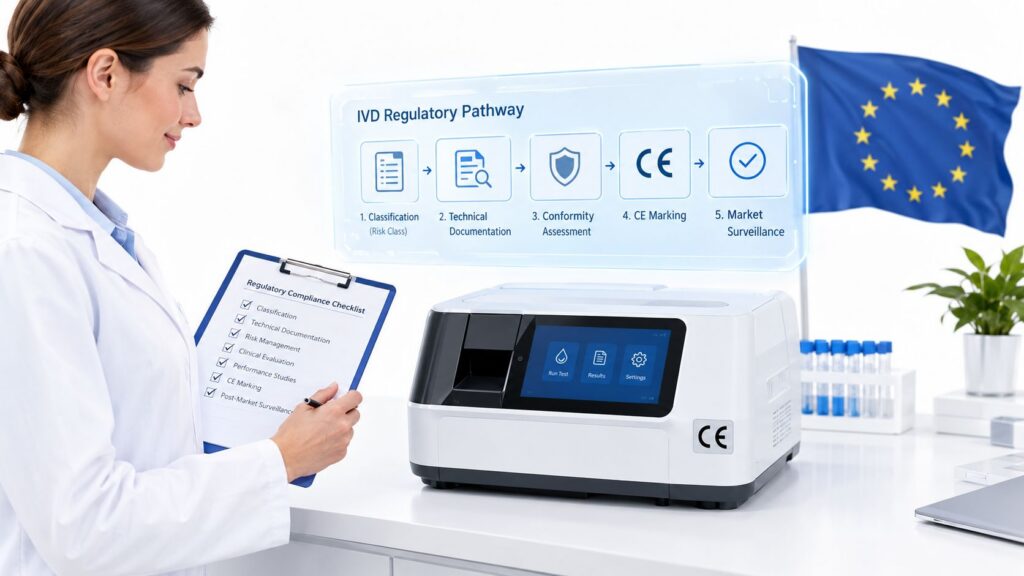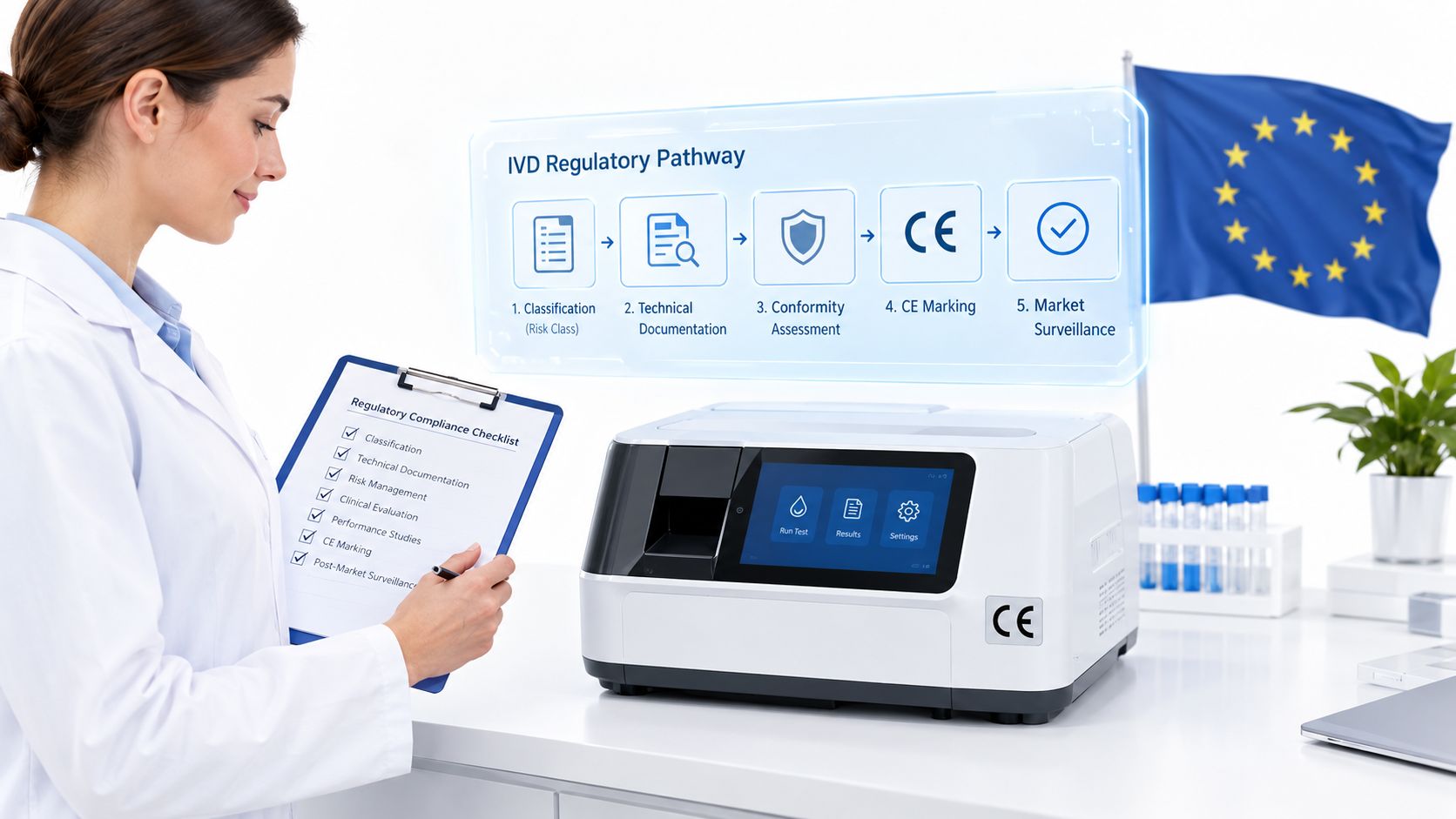
The shift from Directive 98/79/EC to Regulation (EU) 2017/746, the In Vitro Diagnostic Regulation, changed the route to IVD CE marking more significantly than many legacy transition summaries suggest. Under the former directive, most IVDs were self-certified by their manufacturers. The IVDR has applied since 26 May 2022, and the European Commission's factsheet for IVD manufacturers states that around 85% of all IVDs need notified body oversight under the new rules (European Commission factsheet).
That, however, is where the popular advice becomes misleading. The transition calendar matters, but classification decides the conformity route, the evidence burden and the time required. This article explains how qualification, Annex VIII classification, conformity assessment, performance evaluation, technical documentation, declaration, CE marking and post-market obligations form one connected route under the IVDR.
Background
The CE mark is not the final step in an IVD project. Classification is the decision that drives the conformity route, evidence burden and delivery timeline. Under the IVDR, a weak classification decision can force a manufacturer to rebuild its quality system, performance evidence and notified body schedule after development is already underway.
The IVDR was adopted on 5 April 2017, entered into force on 26 May 2017, and became applicable on 26 May 2022, replacing Directive 98/79/EC for IVD CE marking in the European Union (Regulation (EU) 2017/746). The earlier system allowed many manufacturers to affix the CE mark through self-certification. The IVDR introduced expanded risk classes and brought much more of the market into notified body assessment.
The practical sequence is clear. The intended purpose determines whether the product falls within the IVDR. Annex VIII determines the class. The class then determines the conformity assessment route, the need for notified body involvement, the depth of performance evaluation and, for Class D devices, additional expert and verification requirements. These are one programme, not separate compliance tasks.
The transition was extended by Regulation (EU) 2022/112 and amended again by Regulation (EU) 2024/1860. Under the amended transitional conditions, Class D legacy devices are permitted to remain under transition until 31 December 2027, Class C until 31 December 2028, and Class B and sterile Class A until 31 December 2029, provided the applicable conditions are met. Those dates do not preserve market access automatically. The manufacturer must satisfy the relevant requirements, including timely notified body engagement, a signed agreement and no significant design or intended-purpose change.
The application deadlines for legacy Class D and Class C devices have passed. The deadline for legacy Class B and sterile Class A devices is 26 May 2027. Waiting for the final transition date is poor regulatory planning. Manufacturers should establish the classification and conformity route early enough for review of the QMS, technical documentation and performance evidence before the applicable transition expires.
Qualification and the Worked Example
Qualification comes before classification, and the intended purpose statement is the document to test first. Article 2(2) IVDR defines an in vitro diagnostic medical device by its intended use, covering reagents, calibrators, control materials, kits, instruments, equipment, software and systems used to examine human specimens in vitro and provide diagnostic information.
Apply that test to the product as marketed, not to its physical form. A software-only product can qualify when it analyses data from human specimens and reports information for diagnosis, screening, prediction, prognosis or treatment selection. Software supplied with an IVD must also be assessed according to the function it performs and its relationship with the device. Software that performs the diagnostic function in its own right cannot avoid the IVDR because it has no cartridge, analyser or consumable.
The intended purpose must state the output and its clinical use with enough precision to support a regulatory decision. “Analyses sequencing data” describes a technical operation. “Identifies variants in tumour samples to support selection of a medicinal therapy” connects the output to treatment, creating a different performance evidence and classification question.
Hypothetical sequencing example
Consider software that analyses sequencing data from tumour samples and reports variants used to select a cancer therapy. The first qualification question is whether the software provides information from the in vitro examination of human specimens. If the intended purpose says that it does, the software falls within the IVD definition even when the sequencing instrument and wet-lab process are supplied separately.
The manufacturer must then examine each potentially applicable Annex VIII rule against the exact claims. The product name, algorithm type and delivery format do not determine the class. Rule 3 requires close attention because it covers devices intended to determine a patient's susceptibility to a medical treatment or predict treatment responses, including companion diagnostic functions. The manufacturer must establish whether the intended purpose meets the IVDR companion diagnostic criterion, rather than treating therapy-selection language as harmless marketing copy.
Other claims may change the analysis. If the software also reports a result about an infectious agent, the manufacturer must assess the relevant infectious-agent rule. Specimen type, output wording and the consequence of an incorrect result can affect the applicable rule. The highest applicable rule sets the classification, which then drives the conformity route, the depth of performance evidence and the review schedule.
For a Class D device, that schedule may also include additional consultation and scrutiny. Those activities should be planned with the notified body route and evidence work, not handled as separate projects after classification. A weak intended-purpose statement therefore creates delays across the whole programme.
The example has no final class because a defensible decision requires the complete intended purpose, claims, specimen context and output, not an isolated description of the algorithm.
Classification Under Annex VIII
Classification is the decision that sets the entire IVDR workplan. It determines the conformity assessment route, the depth of performance evaluation, the notified body workload and, for Class D devices, the additional scrutiny that can extend the submission timeline. Treating classification as a short compliance formality is a reliable way to create rework.
Annex VIII contains seven classification rules. They assess the intended purpose, the device's function and the consequences of an incorrect result. Classification is not an average of the product's features, and the manufacturer cannot select the least burdensome applicable rule. If several rules apply, the highest resulting class governs, as set out in IVDR Annex VIII and Article 47.
Use this decision flow in the classification memo:
Step 1: Test Rules 1 and 2 first. Rule 1 places in Class D devices that detect transmissible agents in blood, blood components, cells, tissues or organs to assess their suitability for transfusion, transplantation or cell administration, devices that detect a transmissible agent causing a life-threatening disease with a high or suspected high risk of propagation, and devices that determine the infectious load of a life-threatening disease where monitoring is critical. Rule 2 covers blood grouping and tissue typing for immunological compatibility. These devices are Class C, unless they determine the specific markers listed in the rule (within the ABO, Rhesus, Kell, Kidd and Duffy systems), in which case they are Class D.
Step 2: Test Rule 3. This rule places a long list of purposes in Class C, including detection of sexually transmitted agents, specified infectious-agent and immune-status determinations, companion diagnostics, cancer screening, diagnosis and staging, human genetic testing and the management of life-threatening conditions. The assessment must focus on what the output is used to decide, not only on the analytical method.
Step 3: Test Rule 4. Self-testing devices are Class C, except for the self-tests the rule places in Class B, such as pregnancy, fertility, cholesterol and glucose tests. Near-patient testing devices are classified in their own right.
Step 4: Test Rules 5 to 7. Rule 5 covers specified general laboratory products, accessories with no critical characteristics, buffers, washing solutions, general culture media, instruments and similar devices intended for particular in vitro diagnostic procedures. These are generally Class A. Rule 6 covers devices outside Rules 1 to 5 and generally results in Class B. Rule 7 covers control materials without a quantitative or qualitative assigned value and results in Class B.
The wording of the intended purpose controls each step. Specimen type, user, operating environment, data source and the clinical consequence of an incorrect result can change the applicable rule. Rule 5, for example, does not mean that every laboratory product qualifies as an IVD.
MDCG 2020-16 helps explain how to apply the rules, but it is guidance rather than legislation. The classification memo should identify the intended purpose, record every rule considered, explain why each rule applies or does not apply, and document the basis for the highest applicable class.
For a software-only IVD, record the clinical decision supported by the output and its connection to treatment. A weak classification decision then affects the route, evidence plan and review schedule at the same time. That is why classification should be approved before the manufacturer fixes the technical documentation plan.
Conformity Assessment Routes
Classification is the decision that sets the entire IVDR timetable. It determines whether the manufacturer can self-declare, when a notified body must enter the process, how much evidence the review will require, and which Class D consultations may delay completion. Treating conformity assessment as a separate task after classification creates avoidable rework.
Non-sterile Class A devices can generally use the manufacturer self-declaration route. The manufacturer prepares the technical documentation, demonstrates conformity with the applicable requirements, and draws up the EU declaration of conformity under Article 17. Annex IV provides the declaration framework, alongside the applicable technical documentation requirements.
Sterile Class A devices require notified body assessment of the sterile aspects. Class B, Class C and Class D devices also require notified body involvement. The manufacturer can generally use the quality management system and technical documentation route in Annex IX, or combine production quality assurance under Annex X with product verification under Annex XI. Both routes pursue the same legal objective, but they organise the assessment, sampling and review activities differently.
| Class | Applicable annex(es) | Notified body required | Class-specific steps |
|---|---|---|---|
| Class A, non-sterile | Annex IV, with the applicable technical documentation requirements | No, unless another feature requires involvement | Manufacturer self-declaration |
| Class A, sterile | Annex IX, or Annexes X and XI for the applicable route | Yes | Assessment of the sterile aspects |
| Class B | Annex IX, or Annexes X and XI | Yes | Class-dependent technical documentation and QMS assessment |
| Class C | Annex IX, or Annexes X and XI | Yes | For companion diagnostics, the notified body consults a medicines competent authority or the EMA |
| Class D | Annex IX, or Annexes X and XI | Yes | EU reference laboratory verification where one is designated, and expert panel views on the performance evaluation where no common specifications exist |
Choose the route before the performance file is finalised. The route affects the evidence the notified body will examine, the QMS assessment, document readiness and the review schedule. It therefore belongs in the same project plan as classification and performance evaluation, not in a later regulatory workstream.
Class D devices add dependencies that can extend the timeline. Where an EU reference laboratory has been designated, the device may require laboratory verification of specified performance or batch-related aspects. Where common specifications do not exist, an expert panel provides its views on the manufacturer's performance evaluation report. Companion diagnostics sit in Class C under Rule 3, and for these the notified body consults a medicines competent authority or the EMA (European Commission factsheet).
The Commission's common specifications for certain Class D devices are set out in Commission Implementing Regulation (EU) 2022/1107. Check whether the device and its intended purpose fall within those specifications before fixing the evidence strategy.
Performance Evaluation and Technical Documentation
Performance evaluation is where most IVDR submissions become difficult. The manufacturer must establish scientific validity, analytical performance and clinical performance under Article 56 and Annex XIII, then maintain the evidence throughout the device's life.
Scientific validity connects the analyte or marker with the clinical condition, physiological state or clinical outcome claimed by the manufacturer. A literature review that merely collects papers about a technology isn't enough. The evidence must support the specific association and intended purpose.
Analytical performance addresses how the device measures or detects the relevant characteristic. Depending on the device, the file may need evidence concerning trueness, precision, accuracy, analytical sensitivity, analytical specificity, detection or quantification limits, cut-off values and interfering substances. Those studies must reflect the claimed use and the relevant specimen types.
Clinical performance shows whether the device produces results that support the intended clinical purpose in the intended population. Sensitivity, specificity, predictive values and expected values may be relevant, but the manufacturer must justify the selected endpoints and the evidence route. Clinical performance can be supported through clinical performance studies, peer-reviewed literature and published routine diagnostic testing experience where the manufacturer explains why the evidence is sufficient and appropriate.
The weak point is often not the bench testing. Manufacturers tend to generate extensive analytical data while leaving the scientific validity and clinical performance arguments dependent on broad literature claims or retrospective marketing material.
The file and the lifecycle
The performance evaluation report belongs in the technical documentation under Annex II. Annex III adds the post-market surveillance documentation, including the post-market performance follow-up plan and the process for updating performance evidence. The file should show a clear relationship between:
the intended purpose and classification;
the state of the art;
the literature-search methodology and protocol;
the device-specific claims;
the performance studies and other evidence;
the risk assessment and general safety and performance requirements; and
the post-market evidence plan.
My advice is simple: start the performance evaluation report before classification is treated as final. A later change from a lower to a higher class can alter the evidence scope, the notified body route and the timeline. Performance evaluation is an iterative QMS process, not a document assembled at the end of product development.
For software-enabled and AI-adjacent IVDs, study design can become the limiting factor. The MDCG 2025-5 guidance on IVDR performance studies addresses the regulatory handling of performance studies, including authority and ethics submissions and the assessment of substantial modifications. It should be read as guidance, not as legislation, but ignoring its expectations creates avoidable questions during review.
Declaration, CE Marking and Post-Market Obligations
The final pre-market documents are short compared with the evidence behind them, but they carry legal weight. Under Article 17, the manufacturer draws up an EU declaration of conformity identifying the device, the applicable regulation and the conformity assessment route. The declaration must match the device, intended purpose, class and certificates. A generic declaration copied from an earlier IVDD file is not adequate.
The manufacturer affixes the CE marking under Article 18 after the applicable conformity assessment has been completed. Where a notified body has been involved, its identification number accompanies the CE mark. For a non-sterile Class A device following self-declaration, that notified body number isn't added merely because the manufacturer has a general relationship with a notified body.
The QMS under Article 10 and the Person Responsible for Regulatory Compliance under Article 15 must be in place as part of the operating model, not added after certification. The PRRC must meet the qualification conditions in Article 15(1), and the QMS must control design, production, performance evaluation, conformity assessment, vigilance and post-market surveillance.
Post-market evidence
Post-market obligations begin when the device is placed on the market. The manufacturer must operate a PMS system under Article 78, collect relevant performance information, assess complaints and incidents, report serious incidents and implement field safety corrective actions where required.
The reporting document depends on class:
Class A and Class B manufacturers prepare a PMS report under Article 80.
Class C and Class D manufacturers prepare a periodic safety update report under Article 81, updated at least annually.
Class C and Class D manufacturers also draw up a summary of safety and performance under Article 29, which is made public through EUDAMED.
All classes: post-market performance follow-up forms part of the PMS plan (Annex III) and is set out in Annex XIII Part B. If it is not considered appropriate for a device, the manufacturer must justify that in the performance evaluation report.
The post-market performance follow-up evidence feeds back into the performance evaluation report. That means the manufacturer must assign ownership, define data sources and establish update criteria before the first certificate is issued. A post-market system that exists only as a procedure in the QMS won't support a device whose clinical claims change or whose use expands.
For manufacturers using an external EU representative, the authorised representative role is governed by Article 11. The representative's responsibilities shouldn't be confused with those of the PRRC, the manufacturer or the notified body.
Transitional deadlines
Regulation (EU) 2024/1860 makes the legacy transition conditional and class dependent. The end of the transition is not the date by which a manufacturer can first approach a notified body. The manufacturer must submit the application and sign the required written agreement within the applicable windows.
| IVD Class | End of Transition | NB Application Deadline | NB Agreement Signed By |
|---|---|---|---|
| Class D legacy devices | Scheduled to end on 31 December 2027 | 26 May 2025 | 26 September 2025 |
| Class C legacy devices | Scheduled to end on 31 December 2028 | 26 May 2026 | 26 September 2026 |
| Class B legacy devices | Scheduled to end on 31 December 2029 | 26 May 2027 | 26 September 2027 |
| Class A sterile legacy devices | Scheduled to end on 31 December 2029 | 26 May 2027 | 26 September 2027 |
| Class A non-sterile legacy devices | No extended transition under the IVDR transition mechanism | Not applicable | Not applicable |
The European Commission's transitional provisions page sets out the conditions attached to the extended periods. Manufacturers must also check whether the device has changed in design or intended purpose, and whether the former certificate and market position still meet the relevant conditions.
Conclusion
The timeline runs in a fixed order. Qualification decides whether the IVDR applies. Intended purpose and Annex VIII decide the class. The class decides the conformity assessment route. That route decides notified body involvement and the extra steps for Class D. The same class and intended purpose then set the depth of the performance evaluation and technical documentation, and that evidence supports both certification and post-market maintenance.
In practice: classify first, build the performance evidence in parallel, and engage the notified body before the application window becomes the bottleneck. Manufacturers that treat classification, evidence and notified body access as separate projects create avoidable delays between them. They belong on one submission timeline.
For the separate registration workstream, our EUDAMED and UDI registration checklist helps structure actor and device registrations without distracting from the class and route decisions that control market access.
The proposed simplification of the MDR and IVDR framework may change parts of the future process, but it remains a proposal and is not current law. Manufacturers should plan against the IVDR and Regulation (EU) 2024/1860 as they stand.
Frequently asked questions
Does standalone diagnostic software need IVDR CE marking?
Yes, if its intended purpose is to analyse human specimen data and provide information for diagnostic or treatment-related purposes, it can qualify as an IVD in its own right. The relevant legal starting point is the definition in Article 2(2), followed by classification under Annex VIII.
Which IVD class usually requires a notified body?
Sterile Class A, Class B, Class C and Class D devices require notified body involvement under the applicable conformity assessment route. Non-sterile Class A devices can generally use the manufacturer's self-declaration route, subject to the device's actual characteristics and intended purpose under Annexes IV and IX to XI.
Does a companion diagnostic always have the same class as the associated medicine?
No. The IVD is classified under the IVDR based on its own intended purpose and Annex VIII. Where the device qualifies as a companion diagnostic, the conformity assessment can also involve consultation with a medicines competent authority or the EMA under Article 48.
What evidence must an IVD performance evaluation contain?
The performance evaluation must address scientific validity, analytical performance and clinical performance. Article 56 and Annex XIII require the manufacturer to justify the evidence and keep the evaluation current, with the resulting report included in the technical documentation under Annex II.
Can a legacy IVDD device remain on the EU market after its old certificate expires?
Sometimes, but only where the device fits the relevant transitional conditions, the manufacturer met the notified body application and agreement deadlines, and the other requirements of Regulation (EU) 2024/1860 are satisfied. The end-of-transition date alone doesn't preserve market access.
Contact the MedQAIR team for classification analysis and notified body submission planning for an IVD under the IVDR.