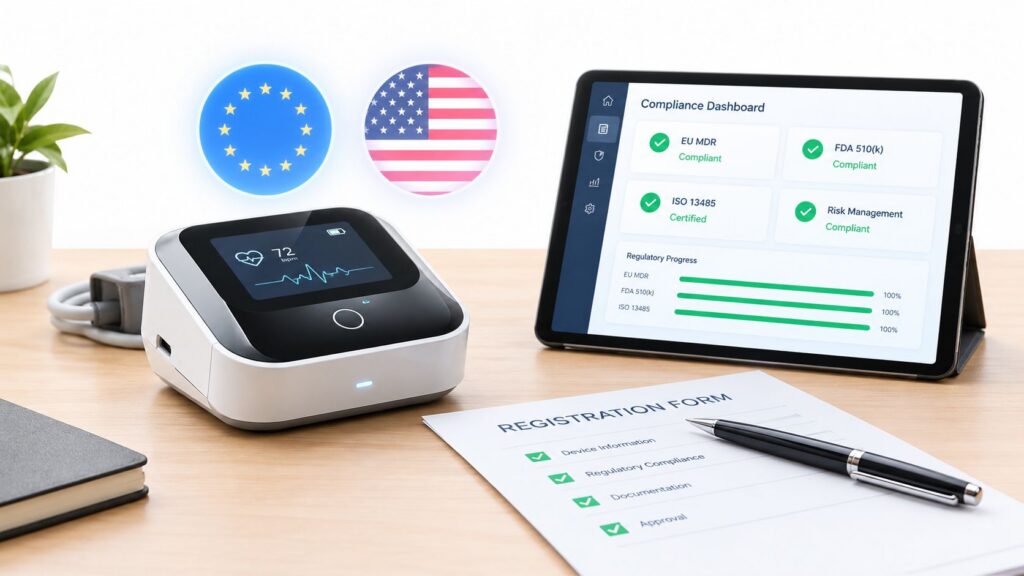
Manufacturers have been able to register in EUDAMED, the European database on medical devices, since December 2020 for the Actor module and since October 2021 for UDI and device data, but only on a voluntary basis. That changed on 28 May 2026. Following Commission Decision (EU) 2025/2371 and the transitional provisions of Regulation (EU) 2024/1860, the first four EUDAMED modules are now mandatory to use (European Commission). In the United States, FDA requires the owners or operators of device establishments to register every year and to list their devices; registration takes place under section 510 of the FD&C Act (Federal Register).
What the two systems have in common is easily misunderstood. The registration of medical devices records a right to place a device on the market; it does not create that right. In this post we outline what registration involves in the EU and the US, in which order the steps are taken, and where manufacturers typically lose time.
Registration is not market authorisation
In the EU, a device reaches the market through conformity assessment and CE marking under the MDR or IVDR. Registration in EUDAMED follows from that work. The MDR addresses the UDI system in Article 27, the registration of devices in Article 29 and the registration of manufacturers, authorised representatives and importers in Article 31 (see also MDCG 2021-13 Rev. 1) (MDR); the IVDR follows the same structure in Articles 24, 26 and 28 (IVDR).
In the US, establishment registration and device listing are governed by 21 CFR Part 807 and are separate from the premarket routes: 510(k), De Novo and PMA (FDA). FDA is explicit about the distinction: registration of a device establishment or assignment of a registration number “does not in any way denote approval of the establishment or its products”, and any representation that creates an impression of official approval is misbranding (21 CFR 807.39). FDA also states that where a device requires premarket clearance or approval, the establishment has to wait until the 510(k), PMA or other submission is cleared or approved before registering and listing the device (FDA, When to register and list).
| European Union | United States | |
|---|---|---|
| Market access | Conformity assessment and CE marking (MDR, IVDR) | 510(k), De Novo or PMA, unless exempt |
| Who registers | Economic operators register in the Actor module; manufacturers submit UDI/device information for the devices they place on the EU market | Owners or operators of establishments involved in the production and distribution of devices intended for use in the US |
| Database | EUDAMED | FDA Unified Registration and Listing System (FURLS) |
| Identifiers | Actor ID/Single Registration Number (SRN), Basic UDI-DI, UDI-DI | Establishment registration number, owner/operator number, premarket submission number |
| Foreign manufacturers | Must have an active authorised representative and submit a mandate summary document with the actor registration request | Must identify a U.S. Agent as part of establishment registration |
| Recurring obligation | Keep actor and device data up to date | Registration submitted every year between 1 October and 31 December, with a review of listings |
Sources: European Commission, Actor registration module and UDI/Device registration; FDA, Device Registration and Listing, When to Register and List and U.S. Agents.
The practical consequence is that registration is where earlier decisions surface. EUDAMED asks for the SRN, the Basic UDI-DI and the device data; FDA asks for the premarket submission number that authorised the device. If any of those are still open, registration stalls, and the cause lies upstream.
The EU: actors first, then devices
Actor registration and the SRN
The Actor module is the first of six EUDAMED modules. Every economic operator, meaning EU and non-EU manufacturers, authorised representatives, system and procedure pack producers and importers, must register as an actor before placing devices or system and procedure packs on the EU market. After the national competent authority has assessed and approved the request, EUDAMED generates the Actor ID/Single Registration Number (SRN), an EU-wide unique identifier for the economic operator (European Commission, Actor registration module).
Two documents come with the request. All actors upload a signed declaration on information security responsibilities, and non-EU manufacturers must have an active authorised representative and submit a mandate summary document (European Commission). For a non-EU manufacturer, the authorised representative therefore has to be in place before registration can start. We discussed that role in more detail in our article on the role of the authorised representative.
Device registration in the UDI/Devices module
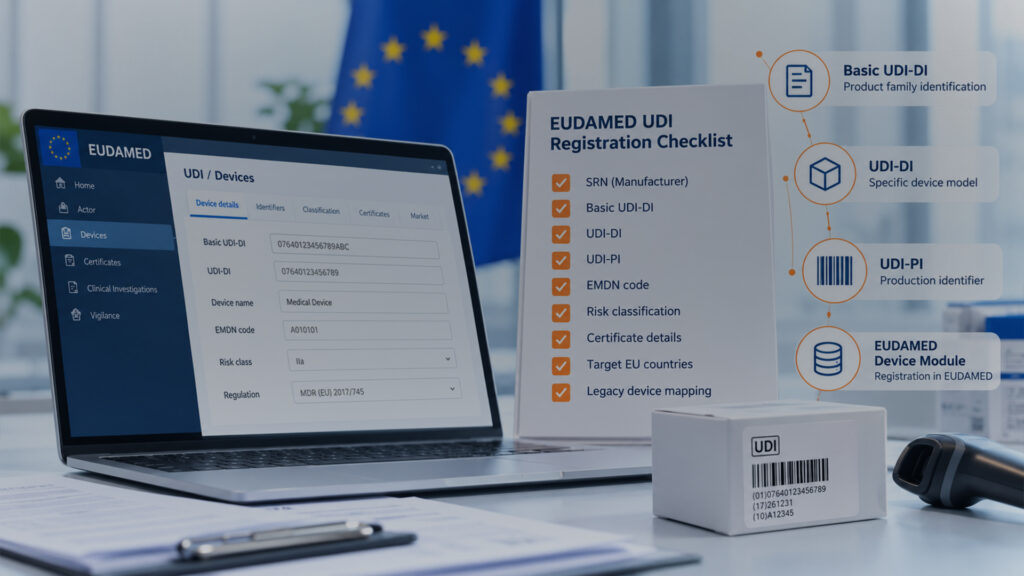
The MDR and IVDR introduce a device identification system based on the unique device identifier (UDI), which requires manufacturers to submit in EUDAMED the UDI/device information of all devices they place on the EU market. The UDI/Devices module has been mandatory to use since 28 May 2026; manufacturers could enter data voluntarily since October 2021. The European Medical Device Nomenclature (EMDN) is the nomenclature to use when registering devices (European Commission, UDI/Device registration).
Devices placed on the market under the former Directives, so-called legacy devices, follow separate rules. Regulation (EU) 2024/1860 establishes the rules for registering legacy devices in EUDAMED, and the Commission has published guidance on managing legacy devices with the EUDAMED DI format (European Commission). Manufacturers with legacy devices still on the market should check those rules and their timing against the Commission’s legacy device guidance. Our EUDAMED UDI registration checklist sets out the identifiers and data fields in more detail.
Which modules are mandatory
| EUDAMED module | Status |
|---|---|
| Actor registration | Voluntary since December 2020; mandatory since 28 May 2026 |
| UDI/Devices registration | Voluntary since October 2021; mandatory since 28 May 2026 |
| Notified Bodies and Certificates | Mandatory since 28 May 2026 |
| Market Surveillance | Mandatory since 28 May 2026 |
| Other modules | Not yet mandatory |
Sources: European Commission pages on the Actor and UDI/Device modules and the Commission notice.
The US: establishment registration and device listing
Who registers and what is listed
Owners or operators of establishments involved in the production and distribution of medical devices intended for use in the US must register annually with FDA, and establishments that register are generally also required to list the devices made there and the activities performed on them (FDA, Who must register, list and pay the fee). Where a device requires premarket authorisation, the listing includes the premarket submission number, such as a 510(k), De Novo, PMA, PDP or HDE, and registration and listing information is submitted electronically unless FDA has granted a waiver (FDA).
The timing is set out by FDA. Registration and listing information must be submitted within 30 days of an establishment beginning an activity or putting a device into commercial distribution. Foreign establishments must register before exporting products to the US, and domestic importers before importing them. Listings must be updated when, for example, another device is introduced into commercial distribution, a listed device changes, or a device is removed from commercial distribution (FDA, When to register and list).
Foreign establishments and the U.S. Agent
Any foreign establishment that manufactures, prepares, propagates, compounds or processes a device imported into the US must identify a U.S. Agent. Each foreign establishment may designate only one, and the agent’s details are submitted through FURLS as part of establishment registration. The agent must confirm through an automated process that it agrees to act; if it declines or does not respond within 10 business days, the establishment must designate a new one. The agent must reside or maintain a place of business in the US, and its responsibilities are limited: assisting FDA in communications with the establishment, responding to questions about its imported devices and helping FDA schedule inspections. FDA notes that the U.S. Agent has no responsibility for medical device reporting under 21 CFR Part 803 or for submitting 510(k)s (FDA, U.S. Agents).
Annual registration and the fee
Registration information must be submitted every year between 1 October and 31 December, even if nothing has changed, and listing information must be reviewed at the same time (FDA). Establishments required to register must pay the annual establishment registration fee before completing their registration (FDA). For fiscal year 2027, the fee is USD 13,785, applicable from 1 October 2026 (Federal Register, FY 2027 user fee rates). Registration is therefore a recurring obligation that needs an owner and a calendar, not a one-time filing at launch.
Keeping registration data consistent
The registration record is only as good as the master data behind it. Legal entity names, addresses, the SRN, FDA registration and owner/operator numbers, Basic UDI-DIs and UDI-DIs, certificate references and premarket submission numbers should come from one controlled source and change only through change control. A change of legal name, a new authorised representative or U.S. Agent, a site move, a renewed certificate or a new device variant should trigger a review of every register in which the device appears, at the same time as the technical documentation is updated.
The same discipline applies between the registers and the product itself. A device name in an FDA listing that differs from the cleared or approved device, or EUDAMED data that differs from the label, creates questions that are easier to prevent than to explain.
Example: a SaMD manufacturer registering in both markets
To show how the steps connect, take a hypothetical case. A software manufacturer established in the Netherlands has a SaMD with an MDR certificate from its notified body, and a 510(k) clearance for the same software in the US.
In the EU, the manufacturer registers in the Actor module, uploads the declaration on information security responsibilities, and receives its SRN once the Dutch competent authority has approved the request. It then submits the UDI/device information for the software in the UDI/Devices module, using the Basic UDI-DI and UDI-DI it has assigned and the applicable EMDN code, and checks that the data match its certificate and labelling.
In the US, the manufacturer waits until the 510(k) is cleared, then registers its establishment in FURLS within 30 days of beginning commercial distribution, identifies its U.S. Agent, lists the software with its 510(k) number and pays the annual establishment fee before completing registration. Each year between 1 October and 31 December, it submits its registration again and reviews its listing. When a new version of the software requires a new 510(k), the listing is updated once the new clearance is received.
The registration steps themselves are short in both markets. What determines the timeline in an example like this is whether the certificate or clearance, the legal entity data, the representatives and the identifiers are final before registration starts.
Conclusion
In both the EU and the US, registration is the administrative step that follows market authorisation, not the authorisation itself. EUDAMED records the actors and devices behind conformity assessment; FDA registration and listing record what a premarket route has already authorised, and FDA states plainly that registration does not denote approval. With the Actor, UDI/Devices, Notified Bodies and Certificates and Market Surveillance modules mandatory since 28 May 2026, European registration has moved from a voluntary exercise to a condition of placing devices on the market.
Our advice is simple: settle the legal entity, the authorised representative or U.S. Agent, the device identifiers and the certificate or clearance before starting registration, keep one controlled source for that data, and put the annual FDA renewal and every EUDAMED update under change control. If you need support with EUDAMED registration or keeping your records aligned, our regulatory database support team can help, or you can contact the MedQAIR team.
Frequently asked questions
Does registering a device in EUDAMED or with FDA mean it is approved?
No. In the EU, market access comes from conformity assessment and CE marking under the MDR or IVDR; EUDAMED records the actors and devices. In the US, 21 CFR 807.39 states that registration does not in any way denote approval of the establishment or its products.
Does a non-EU manufacturer need an authorised representative to register in EUDAMED?
Yes. According to the European Commission, non-EU manufacturers must have an active authorised representative and submit a mandate summary document with their actor registration request.
When did EUDAMED registration become mandatory?
On 28 May 2026, following Commission Decision (EU) 2025/2371 and the transitional provisions of Regulation (EU) 2024/1860 (European Commission). From that date, the Actor, UDI/Devices, Notified Bodies and Certificates, and Market Surveillance modules are mandatory to use.
When must a device establishment register with FDA?
Within 30 days of beginning an activity or putting a device into commercial distribution, and, where premarket clearance or approval is required, only after the submission is cleared or approved. Foreign establishments must register before exporting devices to the US. Registration is then submitted every year between 1 October and 31 December (FDA).
What does a U.S. Agent do?
A U.S. Agent assists FDA in communications with a foreign establishment, responds to questions about its imported devices and helps schedule inspections. According to FDA, the agent has no responsibility for medical device reporting or for submitting 510(k)s.