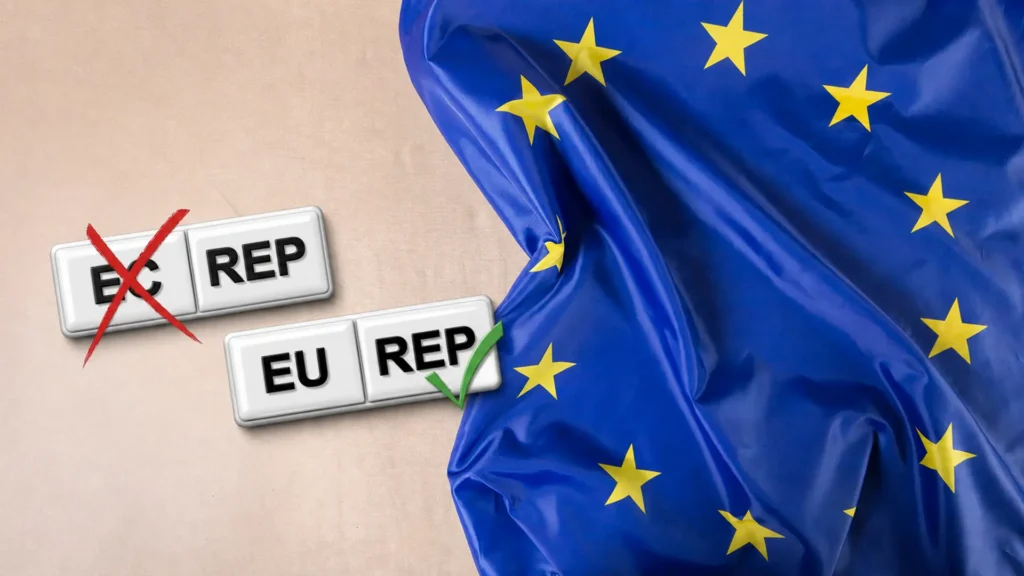
On 17 June 2026, the European Commission published the reference of EN ISO 15223-1:2021/A1:2025 in the Official Journal of the European Union. The amended harmonized standard replaces the ‘EC REP’ symbol with ‘EU REP’ on medical device labeling. Manufacturers now have a confirmed transition path, a five-year window, and accompanying MDCG guidance to navigate the change.
What the OJEU publication formalizes
The symbol change was not new in June 2026. ISO published the underlying amendment (ISO 15223-1:2021/Amd.1:2025) in March 2025. CEN/CENELEC adopted it in November 2025. What June 17th marks is the citation of that standard in the OJEU, which is the step that grants presumption of conformity under the MDR and IVDR.
Two separate Commission Implementing Decisions gave effect to the citation:
- Decision (EU) 2026/1231 of 11 June 2026, amending Implementing Decision (EU) 2021/1182 in support of the MDR
- Decision (EU) 2026/1313 of 15 June 2026, amending Implementing Decision (EU) 2021/1195 in support of the IVDR
Both entered into force on the date of publication. From 17 June 2026, manufacturers can use EU REP on labeling and claim presumption of conformity under the amended standard.
The Transition Deadlines
The OJEU publication sets a five-year transition period:
- 15th of June 2031 under the MDR
- 17th of June 2031 under the IVDR
Until those dates, the original EN ISO 15223-1:2021 reference remains valid. EC REP is still compliant. After the withdrawal dates, only the EU REP confers presumption of conformity.
The five-year window was not set arbitrarily. The Commission Implementing Decisions explicitly acknowledge the operational impact on manufacturers and their supply chains, including artwork revisions across packaging, labels, and instructions for use, at both EU and international levels. Industry input was gathered through the MDCG Subgroup on Standards, which met on the 4th of February 2026 specifically on this topic.
What Actually Changed in the Standard
The amendment makes two substantive changes to EN ISO 15223-1:
- The EC REP symbol is replaced by EU REP. More precisely, the standard introduces a jurisdiction-neutral XX REP framework, where XX is replaced by the applicable two- or three-letter code from ISO 3166-1. For the EU, this gives EU REP. The same framework can be used in other markets with their own representative requirements, such as UK REP or CH REP.
- A formal definition of “authorized representative” is added to the standard (clause 3.20), providing a defined term that was previously absent.
The change is terminological. EC stood for European Community, a designation that became obsolete when the Lisbon Treaty replaced the EC with the EU in 2009. The symbol has carried an outdated reference for over 15 years. An additional practical concern was confusion with EC as the ISO 3166-1 country code for Ecuador.
No device safety or performance requirements change as a result of this amendment. The role and responsibilities of the authorized representative are unaffected.
Practical Implications for Manufacturers
The MDCG published an Appendix to MDCG 2021-5 Rev. 1 alongside the OJEU citation to provide implementation guidance. Several points are worth noting:
- No notified body approval is required to update labeling from EC REP to EU REP. Because the change has no impact on device safety or performance, it does not constitute a significant change under MDR or IVDR that would require prior assessment by a conformity assessment body.
- During the transition, manufacturers may use EC REP, EU REP, or both on different levels of packaging, provided the authorized representative information remains clear and intelligible. This permits staggered rollout across product lines, for example applying EU REP to new product artwork while EC REP continues on existing stock.
- Devices already bearing EC REP and placed on the EU market before the relevant withdrawal date may continue to be made available after that date. This is relevant for products with long shelf lives or large existing inventory.
- Manufacturers with multi-market labeling should also monitor developments in other jurisdictions. Several markets that reference ISO 15223-1 or maintain their own authorized representative requirements may implement equivalent symbol changes. A coordinated approach across label versions is more efficient than market-by-market updates.
Planning the Transition
Five years is sufficient time, but labeling updates across a product portfolio are not straightforward. For manufacturers with many device lines, the practical work includes reviewing all artwork and packaging files, updating technical documentation to reflect the label change, and confirming that any regulatory submissions in other markets are not adversely affected by label version changes.
The most cost-effective path for most organizations is to incorporate EU REP into labeling as part of natural product or packaging revision cycles, rather than initiating a dedicated label change program. Any significant label revision, certification renewal, or new device submission is an opportunity to apply the updated symbol.
A documented transition plan is advisable, both to demonstrate compliance readiness and to coordinate across quality, regulatory, and manufacturing functions.
Questions on how this affects your labeling, quality management system, or technical documentation? Reach the MedQAIR team.