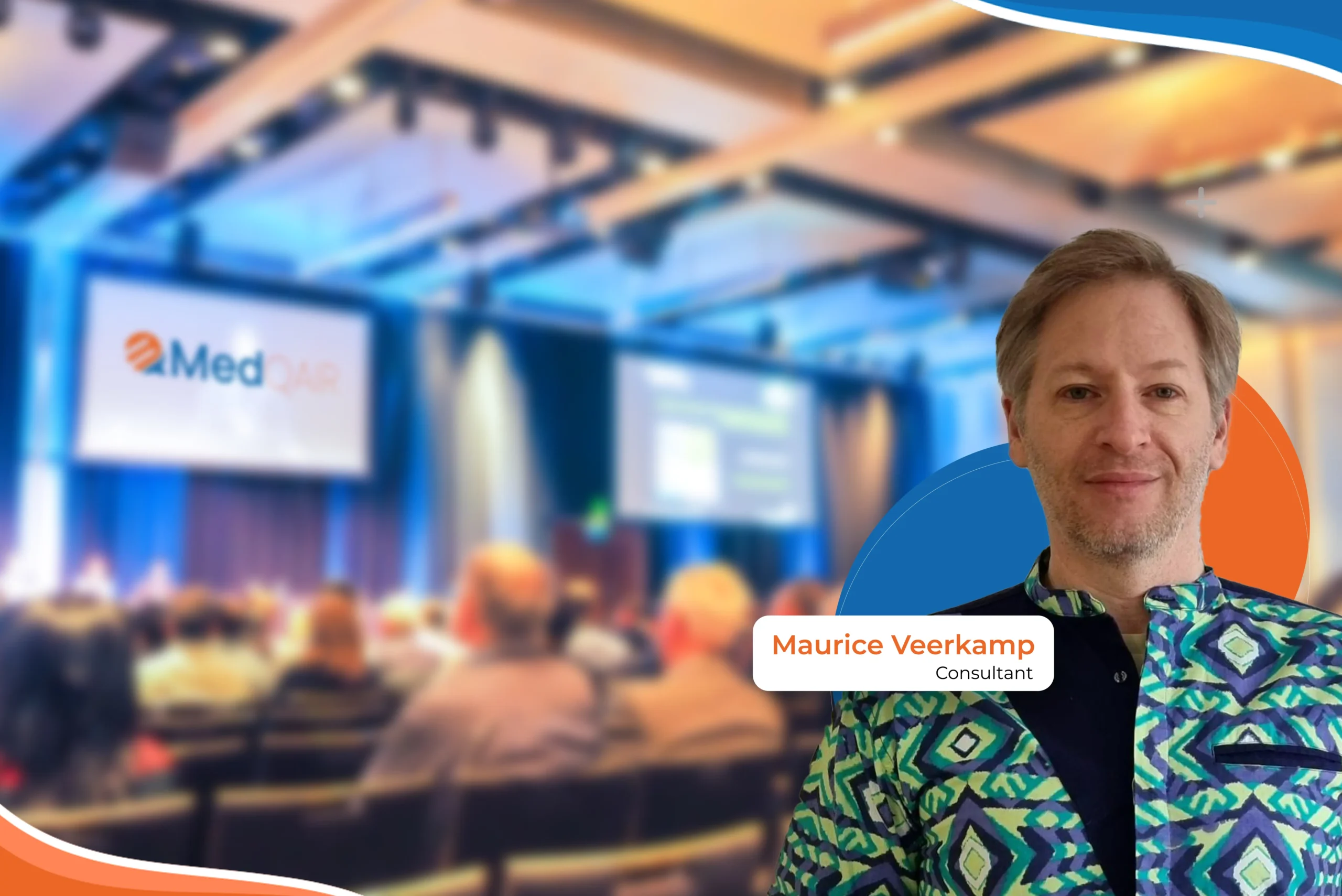
At MedQAIR, our work sits at the intersection of regulatory expertise, quality systems, and digital innovation. Supporting manufacturers of Software as a Medical Device (SaMD), AI-enabled medical technologies, and connected health solutions requires more than theoretical knowledge. It requires professionals who have been part of the journey from early development to market access and post-market maintenance.
Maurice Veerkamp joins MedQAIR as a QA & RA Consultant, bringing hands-on experience across the full SaMD lifecycle. His background combines technical problem-solving, process engineering, usability engineering, and regulatory compliance: a combination that reflects the realities faced by modern digital health manufacturers.
Maurice has worked closely with development teams, quality functions, and commercial stakeholders to build and maintain compliant medical software. His approach is practical and systems-oriented: embedding regulatory requirements into real-world workflows, aligning quality systems with how teams actually work, and ensuring that compliance supports product success rather than slowing it down.
Recently accredited by BSI as an ISO 13485 Internal Auditor, Maurice strengthens MedQAIR’s ability to support clients not only in meeting regulatory expectations but in building QMS frameworks that are efficient, auditable, and scalable. This work aligns closely with MedQAIR’s broader focus on structured, secure regulatory operations, including our recently achieved ISO/IEC 27001:2022 certification, which formalises how regulatory and technical documentation is managed and protected across our services and digital platforms.
In this interview, Maurice shares insights from his career, his perspective on compliance and usability in digital health, and how he sees regulatory and quality disciplines evolving alongside new technologies.
1. You’ve built your career around Software as a Medical Device. What initially drew you to SaMD, and how has the field evolved since you started?
My entry into medtech was almost accidental as I was referred to a startup developing an SaMD for diagnosing femoroacetabular impingement. Hired for my skills in 3D modeling and my instinct for efficiency, I quickly found myself immersed in every aspect of bringing a medical device to market: development, commercialization, and maintenance.
Writing procedures and shaping parts of the QMS became natural focal points, as my drive for efficiency could directly improve workflows and outcomes. I was further drawn in by the tech (AI/ML) used, which aligns with my fascination for new tech. That has been the biggest evolution in the field that I have seen; almost every SaMD now incorporates some form of LLMs or computer vision models, and everyone likes to slap an AI sticker on their product.
But it is clear that SaMDs are becoming increasingly part of the workflows in the Medical field, and this benefits patients and societies as a whole all over the world, whether it’s bringing specialized supportive diagnostic tools for a small group of patients or generalized robot operative plans for a large set of patients.
2. You have experience managing the full SaMD product lifecycle. Which stage do you believe is most often underestimated by manufacturers, and why?
Compliance is frequently underestimated, especially during the early stages of product development. Many teams focus heavily on innovation and functionality, assuming compliance can be squeezed in later. However, integrating regulatory requirements from the start saves time, reduces potential costly redesigns, and ensures smoother market entry. I’ve seen firsthand how late-stage compliance scrambles can delay launches or even force product pivots. It’s not just about checking boxes; it’s about building quality and safety into the core of the product.
3. Process engineering and usability engineering are two areas you specialise in. How do these disciplines strengthen compliance and product safety in digital health?
Process engineering ensures consistency, repeatability, and scalability that are critical for meeting standards like ISO 13485 and IEC 62304. By mapping workflows, identifying bottlenecks, and standardizing procedures, you minimize human error and deviations, which directly supports compliance. Usability engineering, on the other hand, puts the user at the center. Through iterative testing, use-related risks, and human factors analysis, you uncover risks that might not be obvious in a lab but could lead to misuse or harm in real-world settings. Together, these disciplines create a robust approach with “how” and “why” a SaMD aligns with patient and clinician needs.
4. You were recently accredited by BSI as an ISO 13485 Internal Auditor. How does this accreditation influence the way you support QMS optimisation for MedQAIR’s clients?
The accreditation improved my ability to spot gaps between what’s documented and what’s practiced. Many QMS systems exist on paper but fail in execution, whether due to unclear procedures, lack of training, or misaligned incentives. As an auditor, I don’t just assess compliance, but I look for opportunities to streamline workflows, reduce redundancy, and embed quality into daily operations. For MedQAIR’s clients, this means moving beyond just “passing the audit” to check a box, but to building a QMS that actually supports their teams, making compliance a competitive advantage, not a burden.
5. Many manufacturers struggle to translate regulatory requirements into practical workflows. What’s your approach to helping teams bridge that gap?
Regulatory language is often abstract, and being able to understand the implications of a clause and translate it into clear requirements from which concrete actions can follow. Furthermore, workflows should reflect real-world processes. I collaborate with engineering, product, and clinical teams to integrate compliance tasks into their existing tools (e.g., Jira, Confluence) so it feels like part of the job, not extra work. Finally, automation by, where possible, using tools (like MDIS or AI-driven documentation systems) to reduce manual effort and thus freeing teams to focus on innovation while staying audit-ready.
6. From your experience, what are the most common documentation challenges faced by SaMD and AI developers preparing for MDR/IVDR compliance?
Linking user needs, to design inputs, to risk controls, to verification/validation is often fragmented. Teams use separate tools for each stage, making it hard to prove compliance. For AI/ML models, they tend to evolve post-market, but infrastructure and documentation are lacking. Manufacturers struggle to capture the iterative nature (e.g., retraining data, performance drift, etc) of these models in a way that satisfies regulators. Lastly, teams often drown in paperwork, creating “shelfware” that’s never used. The key is focusing on what regulators actually review (e.g., clinical evaluation reports, risk management files) and keeping them lean but thorough.
7. Cross-functional collaboration is essential in digital health. What have you learned about aligning engineering, product, and regulatory teams during development?
The biggest lesson is that shared goals can overcome silos. Engineering teams often see quality and regulatory as additional work that slows them down while regulatory views engineering as cavalier. I’ve found success by ensuring early alignment by involving quality and regulatory in planning, not just as milestones. Additionally, I strongly believe in creating a common language through the use of visual tools like process maps or user journey diagrams to align everyone.
And always remember to celebrate wins!
8. MedQAIR operates at the intersection of regulatory expertise and digital infrastructure. How do you see tools like MDIS improving documentation traceability and post-market readiness?
Tools like MDIS are game-changers because they centralize data. No more digging through emails or shared drives for evidence. A single source of truth for all stakeholders, allowing for reviews and approvals. MDIS enables real-time connectivity, turning the current workflow of reactive decentralised processes into a state-of-the-art proactive centralized process for all stakeholders.
9. Looking ahead, what do you see as the biggest regulatory shifts affecting SaMD and AI-enabled devices, and how should manufacturers prepare?
AI-specific guidance, regulators (FDA, EU) are drafting frameworks for AI/ML as SaMD. We can expect stricter rules on transparency (e.g., explainability of “black box” models, understanding and fixing of “hallucinations” ), data provenance, and post-market monitoring. Manufacturers should start documenting model training data, bias mitigation, and performance thresholds now to avoid retroactive efforts under the pressure of deadlines.
Additionally, cybersecurity is a priority. ISO 27001 and IEC 62443 are becoming expected throughout the industry, and SaMD developers must treat security as a core design principle, not an afterthought.
10. What motivates you in your work, and what value do you hope to bring to MedQAIR’s global community of manufacturers and Economic Operators?
What drives me is the impact, knowing that a well-designed SaMD can give a surgeon confidence, a patient better outcomes, or a small clinic access to state-of-the-art tools. At MedQAIR, I want to help manufacturers see compliance not as a hurdle, but as a strategic tool, one that builds trust, reduces risk, and ultimately gets life-changing products to market faster. My value lies in turning regulatory and quality challenges into strategic advantages, allowing teams to innovate while staying grounded in compliance, so they never have to choose between speed and safety.
Closing Thoughts
Maurice’s perspective reflects a core principle at MedQAIR: compliance works best when it is built into how products are designed, developed, and maintained, and not layered on at the end.
His experience across SaMD development, usability engineering, ISO 13485 quality systems, and AI-related regulatory challenges enables him to support manufacturers in translating regulatory requirements into practical, workable processes. This aligns closely with MedQAIR’s mission to help manufacturers, Authorised Representatives, and other Economic Operators manage compliance with clarity, structure, and confidence.
As we continue to expand our regulatory consulting services and digital infrastructure, including platforms like MDIS for documentation traceability, UDI management, post-market readiness, and our role as the EU’s first fully digital Authorised Representative, Maurice’s expertise adds depth to how we support manufacturers across the full device lifecycle.
We’re pleased to have Maurice as part of the MedQAIR team and look forward to the value he brings to our clients and partners worldwide.
If you’re developing SaMD or AI-enabled medical software and want compliance embedded into real development workflows, MedQAIR helps manufacturers build quality systems that support both innovation and safety. Book a call with MedQAIR to get expert help.